2:00 a.m. makes every phone ring sound like a verdict.
Mine didn’t ring—it exploded, a hospital number lighting up my nightstand like a flare. I was halfway out of bed before the first full buzz finished. Thirty years of badge instincts don’t retire when you do. They just go quiet until something yanks the leash.
“This is St. Mercy,” a woman’s voice said, clipped and careful. “Sir… your daughter has been in a car accident. She’s eight months pregnant.”
The room tilted. I gripped the phone so hard my knuckles went white.
“Is she alive?” I asked.
A pause—short, practiced, the kind medical staff use when they’re choosing which truth to deliver first. “She’s here,” the nurse said. “She’s critical. Please come now.”
I didn’t remember putting on pants. I didn’t remember grabbing my keys. I only remember the cold bite of the steering wheel and the red smear of taillights as I drove like hell through empty streets, jaw locked, heart punching my ribs.
On the way, I kept seeing her the last time I saw her—my daughter, Nora, standing in my kitchen two weeks earlier with a hand on her belly, laughing at something I’d said. She’d looked tired, yes, but happy. Or maybe I’d wanted her to look happy so badly I’d mistaken “surviving” for “fine.”
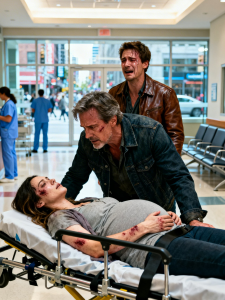
I hit every green light like the city was cooperating out of fear. When I pulled into the ER entrance, the sliding doors swallowed me into fluorescent brightness and the sharp stink of antiseptic. A security guard glanced up, saw my face, and didn’t even bother asking me to slow down.
The waiting area was half-empty, except for one knot of chaos near the triage desk.
My son-in-law was plastered against the wall like gravity had been increased just for him. Evan Hart. Twenty-eight. Pretty-boy face that looked great in wedding photos and terrible under hospital lighting. He was wailing—full-body, theatrical—rocking as if grief needed choreography.
“It was my fault!” he cried to no one and everyone. “Please—save them! Please!”
Too loud. Too practiced.
I’d heard real panic. It doesn’t perform. It splinters.
A nurse tried to get past him with a clipboard and he clutched her sleeve like she was a lifeline. His hands were clean. Not a speck of blood, not a scratch, no grime under the nails. But when he grabbed, the cuffs of his jacket brushed my forearm, and the smell hit me so hard I almost turned my head.
Gasoline.
Not faint like a lawn mower in summer. Sharp and fresh. Like a spill you tried to hide with soap.
Evan saw me and surged off the wall, eyes red and wet. “Frank!” he sobbed. “Frank, I tried—I tried—”
He grabbed my sleeve. His grip was desperate, but his skin felt warm and dry. No tremor. No cold sweat. His fingers were steady.
“Where is she?” I demanded.
“They took her back,” he choked. “They said internal bleeding—baby—oh God, the baby—”
He folded in half, dramatic, like the floor was auditioning.
I didn’t crouch to comfort him. I leaned in until my mouth was by his ear and my voice went low enough that only he could hear it.
“Tell me what you’re not telling them.”
His crying stopped.
Not slowed. Not softened. Stopped—like someone hit pause on a video.
Evan’s head lifted. His eyes met mine, and for a flash, I saw something clean and ugly behind them.
Calculation.
Then he blinked and the performance switched back on. He sucked in a sob, too quick, too controlled. “I don’t know what you mean,” he whispered.
I held his gaze. “Your cuffs smell like gasoline.”
His pupils tightened. “I—I tried to help at the scene,” he stammered, too fast. “There was smoke—maybe… maybe it got on me—”
“Your hands are clean,” I said. “People who ‘help at the scene’ don’t show up smelling like fuel with manicured nails.”
His jaw flexed. The crying threatened to disappear again.
Behind him, the triage doors swung open and a doctor in scrubs stepped out, scanning the room.
“Family of Nora Hart?” the doctor called.
Evan launched forward with a sob like a man on cue. “Me! I’m her husband!”
I stepped beside him. “I’m her father.”
The doctor’s eyes flicked over me, taking in the set of my shoulders, the way I stood. “Come with me,” she said. “Both of you.”
Evan stumbled dramatically, like grief made him clumsy. I followed steady.
We were guided into a small consultation room that smelled like old coffee and disinfectant. A box of tissues sat untouched on the table, like a prop waiting to be used.
The doctor didn’t sit. That told me everything.
“Nora has significant trauma,” she said. “We’re stabilizing her. We’re also preparing for an emergency C-section. The baby’s heart rate dropped en route, but it’s responding now. We’re moving fast.”
Evan made a strangled noise and collapsed into a chair. He covered his face, shoulders shaking.
I watched him through narrowed eyes. The shaking wasn’t random. It was rhythmic. Controlled.
“How did it happen?” I asked.
The doctor glanced at a chart. “Single-vehicle collision. She hit a barrier. EMS reported the car smelled of fuel.”
My stare snapped to Evan.
He didn’t look up. But his shoulders went still for half a second.
I leaned toward the doctor. “Was she conscious?”
“Briefly, at the scene,” she said. “She was disoriented. Then she became less responsive.”
“What did she say?” I asked.
The doctor hesitated. “She… she tried to speak. It was difficult to understand with the oxygen mask.”
Evan’s voice cracked suddenly, perfectly timed. “Please, just—just save her,” he said.
I didn’t take my eyes off the doctor. “Did she say a name?”
The doctor’s mouth tightened. “It sounded like… ‘Evan.’”
Evan let out a sob like he’d been stabbed.
But I felt the hair rise on my arms.
A woman in shock doesn’t call out a name by accident. She calls out what her brain thinks is urgent. A warning. A person. A truth.
The doctor’s voice softened a fraction. “We’ll update you as soon as we can.”
When she left, Evan sprang up and started pacing, hands in his hair.
“I can’t believe this,” he moaned. “I can’t—Nora was fine. She was fine!”
“You weren’t with her?” I asked.
“I was,” he said too quickly. “I mean—no—she left after our fight. She stormed out. I tried to stop her. She took the car.”
The words landed in my chest like ice.
“What fight?” I asked.
Evan’s eyes darted. “It was nothing. Just… pregnancy stuff. She’s been emotional.”
There it was. The easy excuse. The one men use when they want to paint a woman as unstable without saying the word.
I stepped closer. “Show me your arms.”
Evan recoiled. “What?”
“Show me,” I repeated. “Now.”
He backed up until the wall caught him. “Frank, you’re not—”
My voice dropped. “I’m not a cop anymore, Evan. But I’m still a father. Show me.”
He hesitated, then slowly pushed his sleeves up, trying to look offended.
His forearms were clean.
Too clean.
No scratches from broken glass. No bruising from a steering wheel. Nothing that said he’d been in a crash.
But as his sleeve shifted, I saw his wrist.
A faint bruise ringed it—yellowing at the edges.
Old.
Older than tonight.
I stepped closer and looked at his other wrist. Same.
Finger-shaped pressure bruising. The kind you get when someone grabs hard and holds.
Evan yanked his sleeves down, face flushing. “It’s nothing,” he snapped.
“Who grabbed you?” I asked.
He swallowed. “Nora. She—she gets… intense sometimes.”
My blood went cold in a way that had nothing to do with shock.
He was setting the stage.
If Nora died, she’d be the unstable one. The emotional pregnant woman. The one who “lost it.”
And he’d be the grieving husband who tried to save her.
I stared at him and saw my daughter’s wedding day all over again—Nora’s smile tight, her eyes scanning the room like she was waiting for someone to yell. I’d thought it was nerves. I’d been wrong.
Evan rubbed his face, then forced his voice soft. “Frank, please. Don’t do this right now. Don’t—don’t blame me. I loved her.”
I leaned in. “If you loved her,” I said quietly, “you wouldn’t smell like gasoline.”
His eyes flashed. The crying vanished again, replaced by something hard.
For a second, his voice dropped, low and flat. “You don’t know anything.”
Then the door opened and a nurse appeared. “Sir—Mr. Hart? We need you to sign consent forms for surgery.”
Evan’s mask snapped back on. He grabbed the pen with shaking hands, suddenly the devastated husband again. “Yes, yes, whatever you need.”
The nurse glanced at me. “And you are?”
“Her father,” I said.
She nodded, and her eyes did that subtle flick nurses do when they’re reading danger in a room. “We’ll update you,” she said, but her gaze lingered on Evan’s face like she didn’t like what she saw.
When Evan left with the nurse, I didn’t follow. I pulled out my phone and made two calls.
First, to my old partner, Luis. Retired or not, he still answered on the second ring because some habits don’t die.
“Frank?” he said, voice thick with sleep.
“My daughter’s in St. Mercy,” I said. “Car accident. I need you to do me a favor—quietly. Find out who responded. Get me the incident report as soon as it’s written.”
Silence, then: “You think it’s not an accident?”
“I think my son-in-law’s cuffs smell like gasoline,” I said.
Luis swore softly. “I’m on it.”
Second call: to a woman named Denise, a hospital social worker I’d met years ago when I’d escorted victims of domestic violence to get protective orders and they’d ended up here, in these same sterile hallways. Denise didn’t owe me anything, but she’d seen enough to recognize the tremor in my voice.
“Denise,” I said when she answered. “It’s Frank Adler.”
“Frank,” she said, instantly alert. “What’s going on?”
“My daughter’s in trauma,” I said. “Eight months pregnant. And I—” I swallowed hard. “I think she’s been hurt before tonight.”
Denise didn’t ask me why. She didn’t ask if I was sure. She said, “I’m coming.”
That’s what professionals do when they know a clock is ticking.
While minutes dragged, I paced the hallway outside the OR doors. The hospital smelled like bleach trying to scrub fear off the walls. Families whispered and cried. A janitor pushed a mop bucket like the world wasn’t ending in every room.
Evan returned from signing forms, face twisted into anguish again. He leaned against the wall near me like we were on the same team.
“They said it’s bad,” he whimpered. “They said she might not—”
“Stop,” I cut in. “Don’t use her death as a stage.”
His eyes snapped to mine. “What is wrong with you?”
“What’s wrong with me?” I said, voice low. “My daughter is on a table fighting for her life. And you’re rehearsing.”
Evan’s nostrils flared. His hands clenched, then relaxed.
“I didn’t do anything,” he hissed. “Nora was upset. She left. She drove too fast. That’s it.”
I leaned closer. “Then why did she say your name at the scene?”
Evan’s face twitched. “Because she wanted me,” he said quickly. “Because she loves me.”
I didn’t answer.
Because if I answered, I’d say what I really thought—that she’d been trying to warn someone.
Denise arrived twenty minutes later, hair pulled back, eyes sharp. She moved like someone who’d learned to stay calm in chaos.
“Frank,” she said quietly, pulling me aside. “Tell me.”
I kept my voice low, fast. “I smelled gasoline on him. He has old bruises on his wrists he tried to hide. The doctors said the car smelled of fuel. Nora said his name at the scene.”
Denise’s jaw tightened. “Has she ever disclosed abuse?”
“No,” I admitted. “But—” My throat tightened. “I’ve missed things.”
Denise touched my arm briefly, grounding me. “We’re going to do a screening if she regains consciousness. We can also ask the medical team to document any bruising patterns that look older than tonight.”
Evan approached, wiping his eyes. “Who’s this?” he demanded.
Denise’s expression stayed neutral. “Hospital social work,” she said. “We support families.”
Evan’s eyes narrowed. “We don’t need—”
Denise smiled politely. “We’re not asking.”
Evan bristled. “This is ridiculous. You’re treating me like—like a suspect.”
Denise’s smile didn’t change, but her eyes went cold. “We treat everyone the same,” she said. “Especially when a patient is pregnant and injured.”
Evan’s jaw flexed. “She was emotional,” he muttered, almost to himself. “She’s been… difficult.”
Denise didn’t bite. She simply nodded once, like she was filing the words away.
A doctor finally emerged, mask off, eyes tired.
“Family of Nora Hart?”
We rushed forward.
“Nora made it through surgery,” he said. “She lost a lot of blood, but she’s stable for now. We delivered the baby. He’s in NICU—premature, but breathing with support.”
My knees nearly buckled with relief so fierce it hurt.
Evan let out a dramatic sob and clutched the wall. “Thank God! Thank God!”
The doctor continued, “Nora has bruising we’re documenting—some consistent with the crash, some… older.”
Evan’s sob caught.
I met the doctor’s eyes. “Older?” I asked.
The doctor hesitated, then nodded. “We’ll discuss it privately. She’s sedated right now, but when she wakes, a social worker will speak with her.”
Evan’s voice jumped, too high. “Bruises? She bruises easily! She’s pregnant—”
The doctor’s gaze hardened. “We’re trained to recognize patterns, sir.”
Evan’s face went pale.
For the first time since I’d arrived, his performance faltered.
Denise stepped closer to the doctor. “Thank you,” she said quietly.
Evan grabbed her arm. “You can’t interrogate her!” he snapped. “She’s drugged—she’ll say anything!”
Denise pulled free smoothly. “We don’t interrogate,” she said. “We support. And we listen.”
Evan’s eyes burned. “This is a witch hunt.”
I stepped in, chest tight with rage. “The only hunt here,” I said, “is for the truth.”
Evan’s voice dropped, venomous. “You always hated me,” he said, so low only I could hear. “You never wanted her to have a life.”
I leaned in close enough to smell the faint fuel still clinging to him. “No,” I whispered. “I wanted her to have a life that didn’t end at 2:00 a.m.”
He flinched, and I knew I’d hit something real.
They let me see Nora in ICU first.
She looked impossibly small against the bed, tubes and wires making her look like she belonged to the machines more than the world. Her face was pale. Her lips were dry. Her hair—usually thick and shiny—was matted at her temples.
And there, blooming along her upper arm and collarbone, were bruises the crash didn’t explain.
Finger marks.
Old bruises layered under newer ones, like a cruel timeline.
My throat closed. I took her hand, careful of the IV.
“Nora,” I whispered. “Baby. I’m here.”
Her eyelids fluttered but didn’t open. A tear slipped sideways into her hair.
I didn’t know if she could hear me. I spoke anyway.
“You don’t have to protect him anymore,” I said softly. “You don’t have to protect anyone. Just survive. I’ll do the rest.”
Behind me, Denise stood with a nurse, quietly noting what they saw.
When I stepped out, Evan was waiting like a spider in a doorway.
“Can I see her?” he asked, voice trembling.
I looked at him. “Not alone,” I said.
His eyes flashed. “I’m her husband.”
“And she’s my daughter,” I replied. “And I’m done trusting you.”
He took a step toward me, fists tightening.
Then a voice cut through the hall.
“Mr. Hart?”
A uniformed officer approached. Younger, but alert. “We need to ask you some questions about the crash.”
Evan’s face shifted. “Now?”
“Yes,” the officer said. “Now.”
Evan glanced at me, rage and panic wrestling in his eyes. “This is because of you,” he mouthed.
I didn’t respond.
Because right then, my phone buzzed.
Luis.
I stepped away and answered.
“Frank,” Luis said, voice tight. “It’s worse than you think. The responding unit noted a gasoline odor inside the vehicle. Also—there was a red gas can found fifty feet from the barrier, behind a hedge. Like it was tossed.”
My stomach turned. “Was it hers?”
“No,” Luis said. “It’s a cheap can from a convenience store chain. And—get this—there’s traffic cam footage from two blocks back. Someone in a dark hoodie got out of the passenger side before the crash and ran.”
Cold swept through me.
Passenger side.
Evan had said she left alone.
I looked across the hallway and saw Evan being led into a small room by the officer. His shoulders were hunched, but his hands weren’t shaking. Not yet.
“Luis,” I said, voice low, “send me whatever you can.”
“I’ll email what I’ve got,” Luis replied. “And Frank—watch yourself.”
I hung up and stared at the closed interview room door.
My instincts screamed two truths at once: Evan wasn’t just abusive—he was desperate. And desperate men do stupid, lethal things when they’re cornered.
Denise approached me. “We’re going to keep him away from her until she’s awake enough to consent to visitors,” she said. “But you need to be ready. She might deny it. She might protect him.”
“I know,” I whispered.
Because I’d seen women do it a hundred times. Not because they’re weak—because fear rewires the brain. Because love becomes a cage when it’s mixed with terror.
Hours crawled.
In NICU, I saw my grandson through the glass—a tiny, furious life under wires and lights, fists clenched as if he was already fighting the world. I put my hand against the incubator and promised him silently that the world would not be allowed to destroy his mother.
By late morning, Nora’s sedation lightened. Her eyes opened, unfocused at first, then landing on me with slow recognition.
“Dad?” she rasped, voice barely a thread.
“I’m here,” I said quickly. “Don’t talk too much. Just—blink if you can hear me.”
She blinked once.
I swallowed hard. “Nora… did Evan hurt you?”
Her eyes darted toward the doorway, immediate fear flashing like a reflex.
My heart cracked.
“Is he here?” she whispered.
“No,” I said. “He’s not. And he won’t be alone with you.”
Her breath hitched. Tears gathered. One slid down into her ear.
“He said… he said if I told you,” she whispered, “you’d hate me. He said you’d take the baby away.”
Rage burned behind my eyes. “I would never,” I said, voice shaking. “Never. I would take you away from him.”
Nora’s mouth trembled. “He didn’t mean—” she started automatically, then stopped, as if she heard her own excuse and hated it.
I leaned closer. “Nora,” I said softly, “the crash—was it an accident?”
Her eyes squeezed shut. A sob shuddered through her.
“He… he was in the car,” she whispered. “He got in when I was leaving. He said we were going to talk. Then he—” Her voice broke. “He started screaming. He grabbed the wheel. He said if I wasn’t his, I’d be nobody’s.”
My blood went ice-cold.
Denise stepped closer, voice gentle. “Nora, you’re safe right now. Can you tell us what happened with the gasoline?”
Nora’s eyes opened again, wild. “He poured it,” she whispered. “He poured it on the floor by my feet. He said it would look like the car caught fire after impact. He said… he said people would feel sorry for him.”
My stomach lurched.
Denise nodded slowly, already documenting. “Did he leave before the impact?”
Nora blinked, tears spilling. “Yes,” she whispered. “He jumped out when I slowed at the corner. He… he pushed me. He said, ‘Drive.’”
I squeezed Nora’s hand, careful not to hurt her. “You did what you had to do to survive,” I said. “Now we do what we have to do to keep you alive.”
Nora’s gaze clung to mine. “He’s going to say I’m lying,” she whispered.
“Let him,” I said, voice turning hard. “We’ve got cameras. We’ve got the gas can. We’ve got bruises. And now we have you.”
A sob broke out of her, ugly and raw, like a dam finally cracking.
Denise signaled the nurse. “We need hospital security,” she said quietly. “And we need to notify law enforcement with the patient’s statement.”
Within minutes, the ICU hallway changed.
Security appeared. Nurses became sharper, quicker. An officer returned, not the young one—someone older, steadier, who listened like every word mattered.
Evan didn’t take it well.
When they told him he couldn’t visit Nora, his mask finally shattered into real rage.
He stormed down the hall shouting, “This is insane! She’s drugged! She’s confused!”
His mother arrived like a missile, hair perfect, eyes blazing. “Where is my son?” she demanded. “Where is my grandbaby?”
I stepped into her path. “Your son tried to kill my daughter,” I said.
She laughed, short and cruel. “Oh, please. Nora is dramatic. Always has been.”
The words made my hands shake.
In the waiting area, Evan’s mother—Carla—began screaming at staff, at Denise, at anyone who would listen. She knocked over a coffee stand in her fury, cups clattering and spilling brown sludge across the floor. The smell was bitter and stale, mixing with antiseptic in a way that turned my stomach.
Evan paced like a caged animal, then suddenly grabbed a chair and hurled it against the wall.
Plastic cracked. Metal shrieked. People screamed.
“Everyone wants to blame me!” he roared. “She drove! She drove!”
Security moved in fast, but Evan shoved one of them, and it became a wrestling match of bodies and rage—no punches, but plenty of force. Evan’s mother lunged too, grabbing at a nurse’s arm, nails scraping skin.
“Don’t touch my son!” she shrieked.
A security guard shoved her back. She stumbled into a trash can, knocking it over. Used tissues and food wrappers spilled out in a disgusting heap across the tile—hospital trash, the kind that shouldn’t ever touch your shoes.
The whole scene was ugly, loud, shameful.
And through it all, I saw Evan’s face—not grief, not love.
Fear.
Not fear for Nora.
Fear of consequences.
When the officer finally cuffed him, Evan’s eyes found mine.
“You did this,” he hissed.
I stared back. “No,” I said. “You did.”
Evan’s mother screamed my name like it was a curse. She tried to lunge again, but security held her.
“You’re stealing my grandchild!” she sobbed.
I didn’t flinch. “You can cry all you want,” I said. “It doesn’t change what he did.”
They took Evan out.
The hallway quieted slowly, like the hospital exhaled.
I returned to Nora’s room and sat beside her bed. She looked exhausted, face slack with pain and relief and something like shame.
“I’m sorry,” she whispered.
I shook my head. “No,” I said. “Don’t you dare apologize for surviving.”
A fresh tear slid down her cheek. “I thought I could fix him,” she whispered. “I thought if I just—if I loved him enough—”
“That’s the lie they sell you,” I said softly. “That your love is a tool to change a man who enjoys control.”
Nora’s hand trembled in mine. “Will I lose the baby?” she asked, voice breaking.
I swallowed hard. “He’s in NICU,” I said. “Small, mad, and fighting. Just like you.”
Her eyes fluttered shut with relief. “I want to see him,” she whispered.
“You will,” I promised. “And when you do, you’ll see what all this was for.”
Later that day, after the chaos settled, Denise sat with me in the waiting area and spoke quietly.
“We’ll help her file for a protective order,” she said. “We’ll connect her to resources. But Frank—she’s going to need more than paperwork. She’s going to need a safe place where he can’t reach her.”
“She’ll come home,” I said immediately.
Denise nodded. “Good.”
That night, I went to Nora’s apartment with a key she’d once given me “just in case.” The place smelled faintly of vanilla candles and stale fear. I walked through the living room and saw it—an end table with a chipped corner, a picture frame cracked at the edge, a dent in the wall by the hallway like something heavy had been thrown.
Evidence you only notice once you know to look.
In the bedroom, I found a drawer of long-sleeve shirts even though it was summer. Makeup concealer. A journal tucked beneath socks. I didn’t open it. That was her story to tell when she was ready.
But on the closet floor, behind a stack of shoes, I found a small red gas can.
Cheap plastic. Smelling sharp.
My stomach clenched so hard it hurt.
I carried it out like it was a bomb and left it for the officer who met me downstairs.
When I returned to the hospital, Nora was awake again, staring at the ceiling like she didn’t trust the world not to fall.
“Dad,” she whispered when she saw me. “Am I stupid?”
I sat and took her hand. “No,” I said. “You’re human. And you’re alive. That’s what matters.”
She swallowed. “He was so nice at first,” she whispered. “And then he wasn’t. And then he’d be nice again, and I’d think I imagined it.”
“That’s how traps work,” I said. “They don’t slam shut. They tighten one click at a time.”
Nora’s lips trembled. “I’m scared.”
“I know,” I said. “But you’re not alone anymore.”
A week later, my daughter held her baby for the first time—skin-to-skin, trembling hands, tears dripping onto his tiny cap. The NICU nurse smiled softly and said, “He knows you.”
Nora looked up at me, eyes red. “He’s real,” she whispered, like she needed proof that something good could come out of terror.
“He’s real,” I agreed.
Outside that glass-walled room, Evan’s mother tried again.
She showed up with a stack of papers and a loud voice and a fake smile, insisting she had “rights,” insisting Nora was “unstable,” insisting the accident was “tragic” and I was “poisoning” Nora against her husband.
But the hospital had notes. The police had footage. The courts had statements. And Nora had bruises documented older than tonight.
The first time Carla tried to push past security, she got escorted out. The second time, she screamed and threw a potted plant in the lobby, soil exploding across the floor like a dirty little tantrum. The third time, she was warned she’d be charged with trespassing.
She left shouting, “This family is sick!”
And for the first time, I felt something like grim satisfaction.
Because she was right—just not in the way she meant.
The sickness wasn’t Nora.
The sickness was the way Evan had learned to make cruelty look like love and blame look like devotion.
Months later, when Nora was stronger and the baby was home, she sat at my kitchen table—the same one where she’d once laughed with a hand on her belly—and she told me everything.
The first shove. The first apology. The first time he cried and promised to change. The first time he grabbed her wrists hard enough to leave marks and then kissed them like that erased the pain. The way he’d isolated her from friends. The way he’d said, “No one will believe you. Your dad’s a cop. They’ll think you’re dramatic.”
She spoke without drama. Just truth.
And every sentence felt like a stone dropped into a bucket that had been filling for years.
When she finished, she stared at her hands. “I kept thinking if I waited long enough, he’d go back to who he was.”
I reached across the table and covered her hand with mine. “That man was bait,” I said softly. “The real him is what came after.”
Nora nodded, tears slipping. “I hate him,” she whispered.
“I know,” I said. “And you’re allowed.”
She looked up, eyes fierce for the first time in a long time. “He won’t touch my son,” she said.
“No,” I agreed. “He won’t.”
Because this time, the wall around her wasn’t made of fear and excuses.
It was made of witnesses. Documentation. Support. A father who’d finally seen what he should’ve seen earlier.
And a mother—my daughter—who had survived long enough to stop protecting her abuser and start protecting her child.
At 2:00 a.m., my phone had exploded with a hospital number.
But the real explosion was what happened after: the moment a carefully built lie finally shattered under light.
And no matter how loud Evan cried, no matter how practiced his wailing was, no matter how hard his family tried to throw furniture and trash and blame around like weapons—
The truth smelled stronger than gasoline.
Để lại một phản hồi