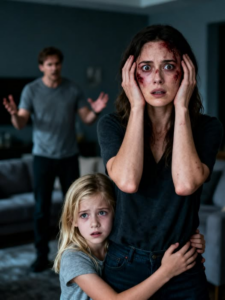
“Just cover it with makeup!” my husband hissed, pushing a tube of concealer into my hands like it was a life jacket.
His fingers pressed into my palm too hard—hard enough to sting—then he leaned close, eyes flat and sharp.
“Nobody needs to know what happened.”
It was still dark outside. The kitchen clock read 6:14 a.m. The house smelled like coffee that had been reheated too many times, that burnt edge clinging to the air like a warning.
I stared at the concealer. Beige plastic. A brand I’d never bought. Something he must’ve picked up yesterday, along with the groceries he always made sure to show the cashier—proof, in his mind, that he was a good man.
A good man who bought milk.
A good man who remembered cereal.
A good man who didn’t “mean it.”
The bruise on my cheekbone throbbed in time with my pulse. It wasn’t the worst bruise I’d ever had. That alone made my stomach twist.
Because once you start ranking bruises, you’ve already lost something you didn’t know could be taken.
I glanced up at him. At the tight line of his mouth. At the way he hovered too close, like even my breathing belonged to him.
“Lena,” he whispered, softening his voice into something that could almost be mistaken for concern, “photo day is important for Mia. You don’t want to ruin that for her. Do you?”
There it was. The hook he always used.
Our daughter.
Mia, seven years old, all knees and bright questions, with hair that never stayed in a ponytail and a laugh that made the house feel less like a cage.
He never said, If you tell, I’ll hurt you worse.
He never had to.
He said, You don’t want to ruin it for Mia.
And I—God help me—I always heard what he meant.
I swallowed. My throat felt scraped raw, like I’d been screaming in my sleep.
“What happened,” I said, my voice thin, “was you.”
His eyes flickered. Not guilt. Calculation.
“Keep your voice down,” he warned. “She’s sleeping.”
I looked toward the hallway, toward Mia’s room with the unicorn nightlight that projected tiny stars onto the ceiling. She’d begged for it at the store, and I’d bought it with my own money. I still remembered the way my husband’s smile had tightened when I did.
He hated when I bought joy without asking.
I tightened my grip on the concealer tube until my knuckles ached.
“Go upstairs,” he said. “Fix it. Put on something nice. Smile.”
Then, as if he were offering a gift, he added, “I’ll drive you both.”
That sentence made my stomach turn colder than the morning air.
Because if he drove, he controlled the route.
If he drove, he controlled the timing.
If he drove, he controlled whether we arrived at all.
I forced myself to nod.
He stepped back, satisfied, and I walked to the bathroom like I was walking on glass.
In the mirror, the bruise looked worse than it felt.
A crescent of purple and green blooming under my left cheekbone, with a faint red imprint at the edge that made it impossible to pretend it was an accident.
But I’d pretended worse.
I’d pretended the time my lip split was because I slipped on the porch steps.
I’d pretended the bruises on my arms were from “bumping into the pantry door.”
I’d pretended the way my voice had gotten quieter was just adulthood.
I had become fluent in lies.
I uncapped the concealer and dabbed it onto my fingertip. The shade was wrong—too warm, too yellow. It wouldn’t cover the bruise fully, but it would mute it enough for a quick smile and a camera flash.
My hand shook.
Not just from fear.
From anger.
Because he bought this like a tool. Like a sponge. Like duct tape. Like silence.
I smoothed the concealer over the bruise carefully.
Then I froze.
A faint, oily streak dragged through the makeup. Something darker than concealer, like a smudge of grease.
I leaned closer.
It was subtle, but there—just along the edge of my cheekbone—was a thin, grayish line. Almost like… charcoal.
Or ink.
I blinked hard, trying to understand.
My mind went back to last night, to the argument that started over nothing and ended the way they always ended—with his voice going cold, his hands moving fast, and Mia’s bedroom door staying shut because she’d learned to be quiet.
But there had been something else last night.
He’d come in later, after I’d locked myself in the bathroom to cry silently into a towel so Mia wouldn’t hear, and he’d shoved something onto the counter with angry energy.
“Look what you made me do,” he’d spat.
I’d seen the flash of a dark object in his hand. Something metal.
I hadn’t focused on it. I’d been focused on breathing.
Now, staring at the mirror, I realized the smudge wasn’t random.
It looked like… residue. Like something transferred.
I lifted the concealer tube and turned it under the bright vanity light.
The cap was smeared faintly with the same grayish stain.
My heartbeat thudded. I knew that stain.
I’d seen it on his hands before.
When he worked on his guns.
I hated them. I hated the way he cleaned them with obsessive care, the way he admired them, the way he said they were “for protection” while my body told a different story.
He wasn’t a hunter. He wasn’t in law enforcement. He was just a man who liked the feeling of power.
And gun oil—gun grease—had a distinct smell and sheen. A metallic slickness that clung to skin.
He must’ve handled the concealer after cleaning.
Or after holding it.
Or—
My mind leapt in a direction that made my stomach drop.
Last night, after he hit me, had he held a gun?
Had he threatened without words?
Had he wanted me to see it?
Suddenly the smear on my face didn’t feel like a mistake.
It felt like a fingerprint.
Evidence.
The kind of evidence I’d always told myself I didn’t have.
I stared at the smudge, the faint gray line slicing through the fake beige cover like a crack in a mask.
Then I did something I didn’t plan.
I reached for my phone.
My hands shook so much I almost dropped it. I opened the camera and leaned close, snapping a picture of my cheek.
The flash made my eyes water.
I took another picture of the concealer cap.
Another of my bruised cheek, with the smear.
Then I pulled open the bathroom cabinet and grabbed a cotton swab, wiping the concealer tube where the stain lingered.
The swab picked up a faint gray residue.
I stared at it like it was a live wire.
“Mom?” a small voice called from the hallway.
I startled, nearly dropping everything.
Mia stood in the doorway in her pajama shirt covered in little suns, her hair sticking up like she’d fought her pillow in her sleep.
“Are we late?” she asked, eyes wide and sleepy.
I forced a smile that felt like tearing cloth. “No, sweetheart. Not late.”
She walked closer, frowning as she studied my face.
Kids notice everything.
“That’s too much,” she whispered, pointing at my cheek. “You look like… like a statue.”
I almost laughed, but it came out broken. “It’s just… makeup.”
Mia’s frown deepened. “Why do you have makeup there?”
Because your father.
Because our house is a trap.
Because love became a quiet war.
I swallowed the truth until it burned.
“I bumped into something,” I lied.
Mia didn’t look convinced. She reached up and gently touched my cheek, careful like she already knew how to handle pain.
My eyes stung.
Mia pulled her hand back and stared at her fingertips.
There, faintly, was a gray smear.
The same stain.
Her tiny fingers held my evidence.
She blinked, confused. “Mom, your face is dirty.”
I stared at her hand like it was a prophecy.
Dirty.
Yes.
Finally.
A thing that couldn’t be explained away by clumsiness.
A thing that transferred.
A thing that didn’t belong.
Mia looked up at me again, and in her expression I saw something that made my chest collapse.
Fear.
Not of the smear.
Of what it meant.
She lowered her voice, glancing over her shoulder toward the hallway, as if the walls listened.
“Did Dad…” she started.
She didn’t finish.
Children in these houses learn to speak in half-sentences.
My mouth went dry.
I crouched to her level and cupped her face gently.
“Go get dressed,” I whispered. “Your photo day outfit. The yellow one.”
Mia hesitated. “Are you okay?”
I wanted to say yes.
I wanted to give her the kind of mother every child deserves.
But I couldn’t lie to her like that anymore.
So I said, “I’m going to be.”
Mia’s eyes searched mine, as if looking for the hidden door out of a maze.
Then she nodded and ran back to her room.
I stood and stared at my reflection again.
The concealer hid the bruise a little.
But it didn’t hide the smear.
And for the first time, I didn’t want it to.
Downstairs, my husband—Cal—stood in the kitchen scrolling his phone with the ease of a man who thought the world belonged to him.
He glanced up when I entered.
His eyes went straight to my cheek.
His mouth tightened.
“What is that?” he demanded.
I touched my cheek lightly, pretending not to know. “Makeup.”
“No,” he snapped, stepping closer. “That mark.”
I tilted my head. “What mark?”
His eyes narrowed. “Don’t play stupid.”
A slow, dangerous heat crept up my spine.
I’d spent years shrinking so he’d feel big.
Today, something inside me refused.
“It’s your concealer,” I said calmly.
He reached up like he might grab my face, then stopped himself, glancing toward the hallway.
He kept his voice low. “Fix it.”
“I did,” I said.
He leaned closer, whispering venom. “You didn’t. It looks like something—like a streak. Like you want people to ask questions.”
I met his eyes.
I didn’t know how to be brave. Not the cinematic kind.
But I knew how to be stubborn.
“It’s fine,” I said.
Cal’s jaw flexed.
He looked like he wanted to say something worse, but then Mia’s footsteps pounded down the stairs and he switched masks like flipping a light.
“There’s my girl,” he sang, too bright, too cheerful.
Mia stopped at the bottom step in her yellow dress, clutching a small comb. She looked at him with a careful expression that broke my heart.
She used to run to him.
Now she measured him.
Cal smiled, bending slightly. “Photo day, huh? You excited?”
Mia nodded, but her eyes flicked to me. To my cheek.
Cal followed her gaze.
His smile faltered, then returned sharper.
“Mom just needs a little more coffee,” he joked. “She’s clumsy in the mornings.”
Mia didn’t laugh.
Neither did I.
Cal grabbed the car keys with a jingle that sounded like a threat, then ushered us toward the door.
The air outside was cold and damp, and the sky was still bruised with night.
As Cal locked the door, he leaned close to me, voice barely audible.
“Smile,” he murmured, “or you’ll regret it.”
In the car, Mia sat in the back with her hands folded in her lap, posture too stiff for a child.
Cal drove like he always did—fast, impatient, one hand on the steering wheel, the other tapping the gear shift like he was drumming for control.
The radio played softly. Some morning show laughing about celebrity gossip.
A different world.
A world where my pain was a rumor that didn’t matter.
I stared out the window and thought about the smear.
That tiny gray line was the first thing that felt real in months.
Not the bruise.
Bruises healed.
But the smear… the smear was proof that he’d touched something else. That he hadn’t been careful enough. That he’d left behind a trace of his obsession, his hidden tools, his metal world.
Maybe it wasn’t enough for court.
Maybe it wouldn’t matter.
But it mattered to me.
Because it told me something important:
He could be caught.
And if he could be caught, he could be stopped.
We pulled into Mia’s school parking lot. Parents lined up in cars, kids hopping out with backpacks and sleepy smiles.
Cal slowed, glancing at me. “You’re coming inside?”
“I want to,” I said.
He scoffed. “Don’t make a scene.”
“I won’t,” I replied.
He stared a moment too long, then nodded sharply. “Fine. But behave.”
He always talked to me like I was a child.
Mia unbuckled and climbed out. I followed, my legs trembling. Cal came around, locking the car behind us as if I might steal it and escape.
We walked toward the school entrance.
And that’s when I saw her.
Ms. Avery.
Mia’s second-grade teacher.
She stood by the doors greeting students, wearing a red scarf and a bright smile that felt like sunlight.
When her eyes landed on Mia, she brightened.
“Mia! And look at you, you’re photo-day ready!”
Mia smiled shyly.
Ms. Avery’s gaze shifted to me.
Her smile softened. “Good morning, Mrs. Holloway.”
Then her eyes flicked to my cheek.
Just for half a second.
But it was enough.
Teachers see everything. Not because they’re nosy. Because they’re trained to notice. Bruises on knees, hollow eyes, sudden silence.
And my cheek, despite concealer, despite careful blending, carried a shadow.
And the smear—a faint gray line—sat there like an underline.
Ms. Avery’s smile didn’t disappear, but her eyes sharpened.
“Are you okay?” she asked quietly.
Cal stepped forward quickly. “She’s fine. Lena’s clumsy. She hit her face on the cabinet.”
He laughed like it was charming.
Ms. Avery didn’t laugh.
She looked at me. Not him.
Her voice stayed gentle. “Mrs. Holloway?”
I felt my heart slam against my ribs.
This was the moment I’d avoided for years.
The moment someone offered a hand.
And I had to decide whether to take it.
Cal’s fingers pressed into my lower back, hard enough to warn.
Mia stood between us, looking up at me like she was holding her breath.
My throat tightened so hard I thought I’d choke.
I heard Cal’s whisper again:
Nobody needs to know what happened.
And then I looked at Mia.
At her small hands. At her careful posture. At the fear she hid behind good behavior.
And something in me rose up like a tide.
I didn’t speak the whole truth.
Not yet.
But I did something smaller.
I let the mask slip.
I looked Ms. Avery in the eyes and said, “Could I talk to you? Alone? Just for a minute.”
Cal’s hand jerked away as if he’d been burned.
“What?” he snapped, too loud.
Parents nearby glanced over.
Ms. Avery’s smile stayed steady. “Of course.”
Cal stepped closer, voice low and furious. “We don’t have time for this.”
Ms. Avery turned slightly, positioning her body in a way that subtly blocked him from me.
A teacher’s shield.
“Mia can go with Mrs. Lang to the photo line,” Ms. Avery said smoothly, motioning to another staff member. “We’ll just take a moment.”
Cal opened his mouth.
Mia looked at him, then at me.
I gave her the smallest nod I could.
She hesitated, then took Mrs. Lang’s hand and walked inside, glancing back once.
Cal’s face darkened.
Ms. Avery’s eyes didn’t leave mine.
“Mrs. Holloway,” she said softly, “please come with me.”
She led me into the office.
Cal followed.
But the office secretary—an older woman with glasses and a no-nonsense jaw—stood up and lifted a hand.
“Sir,” she said firmly, “school policy. Parents need to sign in and wait in the lobby unless escorted.”
Cal bristled. “I’m her husband.”
“And she’s speaking with a teacher,” the secretary replied, unbothered. “Lobby.”
Cal’s eyes flashed.
For a moment, I thought he might explode.
Instead, he smiled—thin, fake, dangerous.
“Fine,” he said. “But we’re leaving right after.”
He leaned close to me, murmuring so only I could hear.
“You just made a mistake.”
Then he walked to the lobby.
My knees almost gave out.
Ms. Avery guided me into a small conference room and shut the door.
The silence inside was different.
Thicker.
Safer.
“Sit,” she said gently.
I sat, hands clenched together.
Ms. Avery didn’t rush. She slid a box of tissues toward me like she’d done this before.
“You don’t have to tell me anything you don’t want to,” she said. “But I need to ask you directly. Are you safe at home?”
The question landed in my chest like a rock.
Safe.
What a simple word. What a complicated truth.
I stared at the table, at the wood grain, at the tiny scratches where someone else had dug in their nails.
My mouth opened.
No sound came.
Ms. Avery waited.
And then I heard myself whisper, “No.”
The word felt like stepping off a cliff.
Ms. Avery exhaled slowly, her face staying calm, but her eyes shining with something fierce.
“Okay,” she said. “Thank you for telling me.”
I shook my head, panic rising. “I shouldn’t have—”
“You did the right thing,” she said quickly. “We’re going to help you. But I need to know: is Mia safe?”
My throat clenched.
He’d never hit Mia.
Not yet.
But safety isn’t just bruises.
Safety is peace.
Safety is not learning how to read footsteps.
I swallowed. “He’s… not like that with her. But she knows. She hears.”
Ms. Avery nodded. “That matters.”
I wiped my eyes with the back of my hand, then remembered the smear.
I pulled out my phone with trembling fingers and opened the pictures I’d taken.
“This—” I whispered, turning the screen toward her. “He made me cover it. And the makeup… it had this… this stuff. Like grease. It got on Mia’s hand.”
Ms. Avery leaned closer, studying the photo.
She didn’t pretend it was nothing.
“That’s a mark,” she said quietly. “And you have bruising visible under the makeup. Mrs. Holloway… Lena… this is serious.”
I flinched at my first name. It sounded too intimate, like kindness.
My chest tightened. “If he finds out—”
Ms. Avery’s eyes sharpened. “He already knows something changed. That’s why we need to move carefully.”
She stood. “I’m going to call the school counselor and our resource officer. We also have mandated reporting laws. But I want to do this in a way that keeps you and Mia safest.”
Mandated reporting.
The words made my stomach drop.
Because I’d built my life around avoiding attention.
Avoiding consequences.
Avoiding the thing Cal always threatened without saying: If you tell, you’ll regret it.
“I can’t go back with him,” I whispered suddenly, the truth erupting.
Ms. Avery nodded. “Then we won’t let you leave unprotected.”
I looked up sharply. “You can do that?”
“We can make sure you’re not alone,” she said. “And we can help connect you with services. A shelter. A restraining order process. Legal aid.”
My hands began to shake so hard my teeth chattered.
“But he’s in the lobby,” I whispered.
Ms. Avery’s face hardened. “Then we handle him here.”
When the counselor arrived, she moved with calm efficiency, the kind of woman who didn’t flinch at pain but didn’t let it swallow her either.
Her name was Dr. Rios. She offered water. She offered tissues. She offered me something I hadn’t been offered in years.
Options.
The school resource officer arrived next—Officer Dane. He didn’t look like TV cops. He looked like someone’s tired uncle in uniform, with kind eyes that didn’t miss details.
He listened while Ms. Avery summarized, careful not to make me retell everything twice.
Then Officer Dane looked at my cheek and said, “May I ask—did he cause that injury?”
My hands clenched. I nodded.
Officer Dane’s gaze didn’t waver. “Do you want to press charges today?”
The question made my stomach roll.
Charges.
Court.
Cal’s rage.
His guns.
I whispered, “I don’t know.”
Officer Dane nodded as if that was normal. “You don’t have to decide everything right now. But we need to keep you safe. Do you have somewhere you can go that he doesn’t know?”
I shook my head. “He monitors everything.”
Dr. Rios leaned forward gently. “We can arrange for you and Mia to go to a safe place. Today.”
The word today made my chest seize.
I’d imagined leaving a thousand times.
But imagination is a luxury when you’re being watched.
I swallowed hard. “What about Mia’s photo?”
Ms. Avery’s eyes softened. “We can still do it. We can give her a normal moment, even if the day isn’t normal.”
Tears spilled down my face then, hot and uncontrollable. “I don’t want to ruin her day.”
Dr. Rios took my hand lightly. “Leaving is not ruining anything. It’s saving it.”
I tried to breathe.
My phone buzzed in my pocket.
A text from Cal.
Where are you. NOW.
My skin went cold.
Officer Dane saw my expression. “He’s texting?”
I nodded, showing the screen.
Officer Dane’s jaw tightened. “Okay. We’re going to talk to him.”
My voice cracked. “He’ll know.”
Ms. Avery said, steady, “He already knows you’re not obedient today. But he doesn’t know what we know. That’s the advantage.”
Advantage.
The word felt strange. Like I could have one.
Officer Dane stood. “Stay here. I’ll handle him.”
My stomach twisted as he opened the door.
I could hear Cal’s voice in the lobby—impatient, too loud.
“This is ridiculous. She’s my wife.”
Officer Dane’s voice was calm but firm. “Sir, we need to speak privately.”
Cal laughed sharply. “About what? My wife’s little meltdown?”
My nails dug into my palms.
Ms. Avery stayed beside me, like a quiet wall.
Dr. Rios walked toward Mia’s classroom to keep her calm and unaware.
Minutes passed like hours.
Then the conference room door opened again and Officer Dane stepped in, face controlled.
“He’s angry,” Officer Dane said quietly. “But he’s staying in the lobby for now. He wants you to come out.”
I shook my head so fast I got dizzy.
Officer Dane nodded. “We’re going to arrange a safe exit.”
I swallowed. “He’ll follow.”
Officer Dane’s gaze was steady. “Not if we stop him.”
Here’s the part people don’t tell you about leaving:
It doesn’t feel like freedom at first.
It feels like chaos.
It feels like standing on the edge of a burning house while someone inside screams that you’re the one setting the fire.
The school arranged it quickly. Officer Dane contacted a local advocacy group. A woman named Tasha arrived within thirty minutes—small, sharp-eyed, wearing a plain jacket and carrying a folder thick with forms.
She looked at me like she’d seen my story a thousand times and still cared every time.
“We can get you and Mia to a safe location,” she said. “But we have to move carefully.”
I whispered, “He has guns.”
Tasha’s expression didn’t change, but her eyes sharpened. “Okay. That changes our safety plan.”
Officer Dane nodded. “We’ll escort them.”
“What about Mia?” I asked, voice trembling. “She’s in class. She’s supposed to—”
Dr. Rios came back then, leading Mia by the hand.
Mia’s face lit up when she saw me, then dimmed when she saw my tears.
“Mom?” she whispered, stepping closer.
I knelt, hands shaking. “Baby… we’re going to go somewhere for a little while.”
Mia’s eyes widened. “Why?”
I glanced at Dr. Rios, at Ms. Avery, at the adults who looked ready to catch me if I fell.
I looked back at Mia.
And I decided to tell her something true without breaking her.
“Because we need to be safe,” I said softly.
Mia swallowed. “Is Dad mad?”
I hesitated.
Then I said, “Dad has made choices that aren’t okay.”
Mia’s eyes flicked to my cheek.
Her voice got very small. “Did he do that?”
My throat closed.
I couldn’t lie again.
So I nodded once, gently.
Mia didn’t cry.
She didn’t scream.
She just stepped forward and wrapped her arms around my neck, holding tight like she was anchoring me to the earth.
“I don’t like him when he’s like that,” she whispered into my hair.
My body shook with silent sobs.
“I know,” I whispered back. “I know.”
Tasha crouched beside us. “Mia, sweetheart, we’re going to take care of you. But we need to go now.”
Mia pulled back and wiped her eyes with the back of her hand like she was copying what she’d seen me do a thousand times.
Then she looked at Ms. Avery. “Can I still take my picture?”
Ms. Avery smiled, bright and real. “Yes. We can do it right now, before you go.”
Mia’s face softened with relief.
And that’s how it happened—how my daughter’s photo day still happened in the middle of my life cracking open.
Ms. Avery walked Mia down the hall to the photo set. I followed, with Officer Dane and Tasha beside me like guards in a fairy tale where the villain was my husband.
Mia stood in front of the blue backdrop, shoulders stiff, hands folded.
The photographer smiled. “Okay, sweetheart! Big smile!”
Mia looked at me.
I forced my mouth into a smile, even though my heart was breaking.
Mia took a breath.
Then she smiled—small, brave, real.
The flash popped.
And in that moment, my daughter’s face was captured forever: a child holding joy like a candle in a storm.
We didn’t leave through the front door.
We left through a side exit near the gym, where Officer Dane’s patrol car waited.
As we walked, my phone buzzed again.
Cal.
This is your last chance. Come out now.
Then another.
You’re embarrassing me.
Then—
If you take my daughter, I swear—
My hands shook so badly I almost dropped the phone.
Tasha glanced at the screen. “Screenshot everything,” she said.
I did, my fingers clumsy.
Mia clutched my hand tightly.
We reached the patrol car.
Officer Dane opened the back door. “Get in.”
My stomach twisted.
It felt like I was the one being arrested.
But when Mia climbed in first, she turned and reached out for my hand again.
And I realized I wasn’t being taken.
I was being carried.
As we drove away, I stared out the window and watched the school shrink behind us.
Cal’s car sat in the lot like a dark spot.
I didn’t see him chase us.
But I could feel him in the air, like thunder before a storm.
The safe house wasn’t what I expected.
I’d imagined something grim. Something crowded. Something that smelled like despair.
Instead, it smelled like laundry soap and tomato soup.
It was a plain building with secure doors, warm lights, and a woman at the desk who smiled at Mia like she mattered.
A room was assigned to us—two twin beds, clean sheets, a small dresser, a lamp shaped like a flower.
Mia sat on the bed and bounced once, testing it.
“Is this a hotel?” she whispered.
I almost laughed.
“It’s a safe place,” I said.
Mia nodded solemnly like she understood more than she should.
That day was a blur of paperwork and whispers.
Tasha explained protection orders. Emergency custody. Safety planning.
Dr. Rios called to check on Mia. Ms. Avery emailed later, telling me Mia’s picture was being printed and would be kept safe at school until I could pick it up.
Officer Dane took my statement. I spoke, voice shaking, reliving moments I’d tried to bury.
And then came the question I’d feared:
“Do you have any evidence?” Officer Dane asked gently.
I swallowed. “Bruises. Photos. Texts.”
He nodded. “Anything else?”
I hesitated.
Then I pulled out the cotton swab in a plastic baggie that I’d shoved into my purse without thinking.
The gray residue was faint but visible.
I showed him.
Officer Dane studied it. “What is it?”
“I think it’s gun oil,” I whispered. “He… he cleans his weapons. And he shoved the concealer at me right after… and it had this smear. It got on Mia’s hand too.”
Officer Dane’s expression changed—subtle, but real.
“Did he threaten you with a gun?” he asked.
I swallowed hard. “Not directly. But… he keeps them. He shows them sometimes. Like a reminder.”
Officer Dane nodded. “Okay. This helps. Not because the swab alone proves abuse, but because it supports your account and indicates the presence of firearms in the home.”
My stomach tightened. “Will that matter?”
“It can,” he said. “Especially if we’re seeking an emergency protective order and removal of firearms.”
My breath caught.
Removal of firearms.
The words felt like pulling a thorn out of my body.
That night, Mia fell asleep quickly, exhaustion pulling her under.
I sat on my bed in the dim light, staring at my phone.
Cal had called seventeen times.
He’d left voicemails that shifted tone like weather.
At first, rage.
Then pleading.
Then sweet, false regret.
“Lena, baby, come home. We can talk.”
“You’re making this worse than it is.”
“Don’t let those people poison you against me.”
Finally, the voice turned cold.
“If you keep this up, you’ll lose everything.”
The last line should’ve terrified me.
Instead, it made me laugh—quietly, bitterly.
Because I’d already lost everything I thought mattered.
And I was still breathing.
The next morning, Tasha took me and Mia to meet a legal advocate.
The building was plain, the waiting room crowded with women who looked like they hadn’t slept in weeks.
I saw myself in their eyes.
A man in a suit asked questions gently, filing motions, arranging emergency orders.
We were granted a temporary protective order by afternoon.
Cal was legally required to stay away.
He was furious.
My phone exploded with messages.
You think paper can stop me?
You’re lying.
You’re ruining Mia.
I’ll make you pay.
I saved everything.
Screenshotted everything.
Evidence, Tasha reminded me, isn’t always dramatic. Sometimes it’s the slow accumulation of a person revealing themselves.
That’s what Cal was doing now—peeling his own mask off with every angry text.
The police attempted to serve him that evening.
He wasn’t home.
He’d gone somewhere.
Hiding.
Plotting.
My skin crawled.
Tasha reassured me. “This is common. But it’s also a good sign. If he’s running, he knows the system is watching.”
Watching.
Another strange word.
I’d been watched for years by him.
Now, finally, someone else was watching too.
On the third day, the call came.
Officer Dane.
“We executed a warrant,” he said. “We recovered firearms from the home.”
My hands flew to my mouth.
Mia sat beside me coloring quietly, head bent over a paper rainbow.
“What kind of firearms?” I whispered, careful.
Officer Dane paused. “Multiple. Including one that was not stored safely.”
My stomach rolled.
He continued, “We also found a cleaning kit. Gun oil. Similar residue to what you described.”
My knees went weak.
“And,” he added, “we found your concealer tube.”
My breath caught.
“You did?” I whispered.
“It was in the kitchen drawer,” he said. “We bagged it. There was residue on the cap.”
The smear.
The fingerprint.
The evidence.
My throat tightened. “Does it… help?”
Officer Dane’s voice was steady. “It corroborates that he handled the tube while handling firearm maintenance materials. Combined with your photos, your statement, and his threatening texts, it strengthens the case for continued protection and firearm restrictions.”
I stared at the wall, trembling.
All those years I’d told myself there was no proof.
That no one would believe me.
That he’d talk his way out of it.
And now, because he shoved a tube of concealer at me with hands that weren’t clean—because he was careless—there was a trail.
It wasn’t a magical key.
It wasn’t instant justice.
But it was something the system could hold.
And I clung to that like air.
Cal didn’t stay hidden long.
Two nights later, the safe house security alarm sounded.
Not a blaring siren—just a sharp beep and the sound of quick footsteps in the hall.
A staff member knocked on my door quietly. “Lena, we need you to come with us. Now.”
My blood ran cold.
Mia woke instantly, eyes wide.
“What is it?” she whispered.
“Just a drill,” I lied, scooping her into my arms even though she was too big, because my body needed to hold her like a shield.
We were moved into an interior room with no windows. The staff locked the door.
Tasha arrived minutes later, face pale but composed.
“Cal was seen near the building,” she whispered. “We don’t know if he knows you’re here, but we’re not taking chances.”
My heart hammered like it wanted to escape my body.
Mia clung to me, trembling.
“Is Daddy here?” she whispered.
I swallowed hard. “No, baby. You’re safe.”
But I didn’t feel safe.
I felt hunted.
Minutes passed like hours.
Then another knock.
Security.
“All clear,” the voice said. “He’s gone. Police are canvassing the area.”
My body slumped with relief so heavy it felt like sickness.
Tasha stayed with us afterward, sitting on the floor beside Mia’s bed.
“He’s escalating,” she said quietly to me. “Which is common when control is slipping.”
My hands shook. “What if he finds us?”
Tasha’s eyes were fierce. “Then we keep moving. We keep you protected. And we keep building the case.”
I stared at Mia, who’d finally fallen asleep again, face crumpled with exhaustion.
“My daughter shouldn’t have to live like this,” I whispered.
Tasha nodded. “Then we make sure she doesn’t.”
Weeks passed.
We moved to a different location.
I changed my number.
We filed for a longer-term protective order.
I began the process for divorce and custody with legal aid.
Cal’s lawyer tried to paint me as unstable, as dramatic, as a woman “influenced by outside parties.”
It was exactly what Cal always said.
But now there were records.
Photos.
Threatening texts.
Witness statements from Ms. Avery and Dr. Rios about my demeanor and the bruise.
The police report about firearms.
And the concealer tube, bagged and tagged, with gun oil residue that matched the kit in his home.
In court, Cal sat in a suit that looked like it was strangling him, his face smooth and controlled.
He didn’t look like a monster.
Monsters rarely do.
He looked at me once, and the look was familiar—the silent promise that he’d punish me later.
Except there was no later now.
There were deputies nearby.
There was a judge above him.
There was a file thick with his own actions.
When Cal’s attorney claimed I’d “fallen,” the judge looked at the photos.
When Cal’s attorney claimed I was “seeking attention,” the judge looked at the texts.
When Cal’s attorney claimed Cal was a “responsible gun owner,” the judge looked at the report of unsafe storage and the warrant execution.
And when Cal tried to speak, to charm, to twist the story the way he always did, the judge stopped him with a raised hand.
“You will answer the question,” the judge said, firm. “Not perform.”
Something shifted then.
Not everything. Not magically.
But enough.
The judge granted a longer protective order.
Temporary sole custody to me.
Supervised visitation only, contingent on evaluation and compliance.
Firearm restrictions upheld.
When the gavel came down, I didn’t feel triumph.
I felt something quieter.
Like my lungs finally had space.
On the way out of court, Mia held my hand tightly.
She wore a small jacket and carried her school photo in a stiff envelope.
She’d insisted on bringing it.
“I want to show Grandma,” she’d said, even though Cal’s mother had always pretended not to see what her son was.
I’d promised we’d show someone safe first.
In the hallway, Mia pulled the photo out carefully and stared at it.
“That’s me,” she whispered, half amazed.
I knelt beside her. “Yes. That’s you.”
Mia looked up at me. “You’re smiling.”
I blinked, startled.
In the photo, behind Mia, a corner of me was visible—just the edge of my face, because I’d been standing off to the side.
And I was smiling.
Not the fake smile I used at family parties.
Not the tight smile I used to survive.
A real one—small, watery, but real.
Mia traced the picture with her fingertip, then frowned slightly.
“Mom,” she whispered, “your cheek looks… different.”
I swallowed.
Because I remembered that day.
The bruise.
The concealer.
The smear.
The beginning.
“It was different,” I said softly.
Mia’s eyes searched mine. “Is it okay now?”
I took a deep breath.
“It’s healing,” I said.
Mia nodded, satisfied with that answer.
Then she did something that made my throat close.
She reached into her pocket and pulled out a tiny tube.
A lip balm.
She offered it to me like it was a treasure.
“For your mouth,” she whispered. “So you don’t get sad.”
I laughed quietly through tears and kissed her forehead.
“Thank you,” I whispered. “But you know what helps the most?”
Mia tilted her head. “What?”
I looked at her—the brave little girl who still smiled for a camera even when her world was shaking.
“You,” I said. “And the truth.”
Later that night, after Mia fell asleep, I sat alone with my phone and opened the first photo I’d taken in the bathroom mirror.
My cheek, bruised, half-covered, the gray smear cutting through the concealer like a confession.
I stared at it and felt something strange.
Gratitude.
Not for the bruise.
Not for the pain.
For the smear.
For that tiny mistake, that careless trace.
Because it became the first piece of evidence I could hold in my hands.
It became the first crack in the wall.
And once a wall cracks, light finds a way in.
I deleted nothing.
I backed everything up.
I built a folder labeled simply: PROOF.
Not because I wanted revenge.
Because I wanted a life.
A quiet kitchen where coffee didn’t smell like fear.
A morning where Mia’s photo day was just photo day.
A mirror where I didn’t need to hide.
Cal’s voice still haunted me sometimes—late at night, in my dreams, in the way my shoulders tensed when a door closed too hard.
But now, there was another voice too.
Ms. Avery’s, gentle and firm:
Are you safe?
And my own whisper, the first truth I’d spoken out loud in years:
No.
That “no” had been the start of everything.
And now, slowly, I was learning to say something else.
Yes.
Yes to safety.
Yes to help.
Yes to my daughter’s laughter without flinching.
Yes to a life my husband’s money, threats, and lies could never buy.
And it all began with one small smear of concealer—an accidental streak that refused to disappear, a mark that showed the world what he tried so hard to hide.
Evidence doesn’t always look like a smoking gun.
Sometimes it looks like a dirty fingerprint on a tube of makeup.
Sometimes it looks like a mother finally choosing truth over silence.
Sometimes it looks like a seven-year-old girl smiling for a camera, not because everything is okay, but because she still believes it can be.
And for the first time in a long time—
I believed it too.
Để lại một phản hồi