
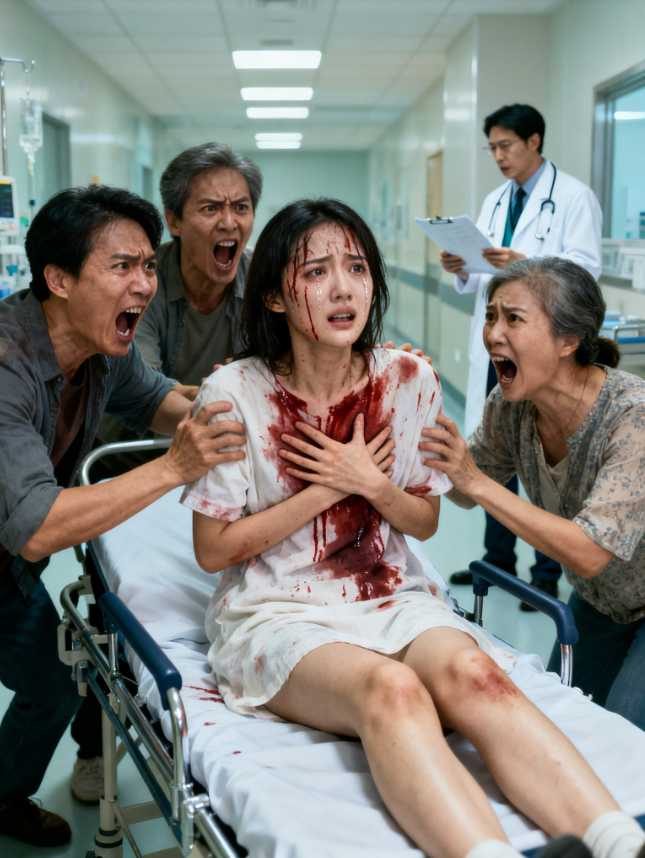
The first time I collapsed, my mother didn’t run to me.
She didn’t scream my name or drop to her knees like moms do in the movies. She didn’t even look scared.
She looked annoyed.
I remember the exact sound my head made when it hit the kitchen tile—soft, somehow, like my body had already decided it didn’t have enough strength to be dramatic. My vision flashed white, then dimmed into a tunnel. Somewhere far away, our refrigerator hummed, steady and normal, like the world didn’t care that mine had just tilted sideways.
arrow_forward_ios
Read morePause
00:00
00:17
01:31Mute
Powered by
GliaStudios
“Emily,” my mom said, the way she said it when I forgot to switch the laundry. Not panicked. Not gentle. Just… irritated. “Get up.”
My cheek was pressed against cold tile. The floor smelled faintly like lemon cleaner and stale coffee. I tried to push myself up, but my arms trembled as if they belonged to someone else.
My father’s chair scraped the floor. “Jesus, Karen. She’s doing it again.”
Doing it again.
Like I was performing.
I opened my mouth to say I couldn’t breathe right, that my heart was sprinting while I was lying still, that my skin felt too tight and too hot and too cold all at once. But words didn’t come out. My tongue was thick. My ears rang.
My sister Brooke laughed from the living room doorway, leaning on the wall like she was watching a reality show. Brooke was twenty, home from community college for the weekend, wearing a cropped sweatshirt and the smug expression she’d perfected years ago.
“Finally,” she said, drawing out the word. “Someone’s calling out her pathetic acting performance.”
My mother’s voice sharpened. “Stop faking it for attention!”
The sentence cut through the ringing in my ears like a knife.
My dad chimed in immediately, like they were a rehearsed duet. “No daughter of ours is this weak.”
Mom added, “Some children just use illness to get special treatment and sympathy.”
Dad agreed, “Real kids don’t need this much drama and constant attention.”
I tried again to move. My fingers scraped the tile, useless.
My stomach rolled.
The room spun.
And then—mercifully—everything went dark.
When I woke up, I was on the couch with a throw blanket thrown over my legs like a peace offering. My mother stood over me with her arms crossed, the queen of the household court. Brooke sat at the other end of the couch scrolling on her phone, bored.
My father watched TV like nothing had happened.
“How long was I out?” I croaked.
Mom glanced at the clock like she was timing a microwave. “Two minutes.”
My mouth was dry as chalk. “I need a doctor.”
Mom’s lips curled. “You need to stop this.”
“Mom,” I whispered. “I can’t—”
“Emily,” she snapped, “you’ve been ‘can’t’ since sophomore year.”
The truth was, she wasn’t wrong about when it started.
Sophomore year, I began getting dizzy when I stood up. My vision would sparkle around the edges. Sometimes the hallway at school seemed too long, like the lockers were pulling away from me as I walked.
I told Mom.
She said I wasn’t drinking enough water.
So I drank water until I felt like my stomach sloshed.
Then I started getting headaches that felt like someone was tightening a belt around my skull. I’d lie in bed with the lights off, nauseous, listening to my heart pound too fast.
I told Dad.
He said I needed to “toughen up” and stop spending so much time “rotting” in my room.
Then came the bruises.
Little purple-blue patches on my thighs and arms, appearing like fingerprints. I hadn’t bumped into anything. I hadn’t fallen. They just… showed up, blooming under my skin like secrets.
I showed Mom one morning while she packed my brother’s lunch. She barely looked.
“You’re clumsy,” she said.
I wasn’t clumsy.
I was scared.
But fear didn’t count as evidence in the Harper household.
If there wasn’t blood, you weren’t hurt. If you weren’t vomiting, you weren’t sick. If you weren’t dying, you were “being dramatic.”
And even dying, apparently, required approval.
After the kitchen-floor collapse, my school insisted I be seen.
Not because my parents believed me. Because the school nurse had a policy, and my parents cared about one thing more than they hated “drama”:
What other people thought.
The next afternoon, Mom drove me to Riverbend Urgent Care with her jaw clenched the entire way, as if the steering wheel had personally offended her. Brooke came too—“to make sure you don’t lie,” she said, sliding into the back seat like a judge on a field trip.
The waiting room smelled like antiseptic and old magazines. A cartoon fish tank bubbled in the corner. I filled out forms with shaky hands.
My mother spoke to the receptionist in a voice meant to be heard.
“She gets faint sometimes,” Mom said. “She’s been… exaggerating things. Teenagers, you know.”
I stared down at the clipboard, cheeks burning.
Brooke whispered from behind me, loud enough for the man next to us to hear. “She wants a chronic illness so bad.”
I bit my lip so hard I tasted iron.
A nurse called my name—“Emily Harper?”—and I stood too fast.
The room tilted immediately.
My knees buckled.
I caught myself on the armrest, breathing shallow.
The nurse’s eyes sharpened with concern. “Whoa. Slow down. Let’s get you back.”
Mom sighed dramatically. “See? This is what we deal with.”
The nurse didn’t respond to her. She guided me through a hallway and into a room with paper-covered exam table. She checked my vitals.
Then her face changed.
My pulse was high. My blood pressure was low. When she clipped the pulse ox to my finger, she frowned like the numbers offended her.
“Have you been bleeding?” she asked.
“No,” I said. “Not— I mean… my period’s been weird.”
Mom rolled her eyes. “Normal teen stuff.”
The nurse ignored her. “Any weight loss?”
I nodded. “A little.”
“Night sweats?”
I hesitated, then nodded again.
Brooke laughed. “Oh my God, she’s really committing.”
The nurse’s expression turned firm. “Ma’am,” she said to Brooke, “please stop.”
Brooke blinked in surprise, like she’d never been challenged by an adult.
The nurse looked back at me. “We’re going to do some bloodwork.”
Mom scoffed. “Is that necessary? She just wants attention.”
The nurse’s eyes were steady. “It’s necessary.”
For the first time in a long time, I felt something I hadn’t realized I’d lost.
Validation.
They took my blood in the lab down the hall. I watched the vial fill with dark red and tried not to think about how tired my body felt, like carrying that blood around was too much.
Then we waited.
Mom scrolled through her phone like the building didn’t contain my fear.
Brooke chewed gum, smacking it obnoxiously.
I stared at a poster on the wall about flu shots and wondered if I’d made all of this up like they said.
Maybe I really was weak.
Maybe I really was dramatic.
Maybe I really was—
The door opened.
A doctor walked in.
He was in his late thirties, with kind eyes and a tired face that suggested he’d seen too much and still showed up anyway. His badge read: Dr. Raj Patel.
He looked at me first—not my mother, not my sister.
“Emily,” he said gently. “How are you feeling right now?”
My throat tightened. “Dizzy.”
Dr. Patel nodded once, then looked down at the chart in his hands.
His eyes scanned.
Then he went still.
Not in a casual way. In a way that made the room tighten.
My mother noticed. “What is it?” she asked, suddenly alert.
Dr. Patel’s voice stayed calm, but something in it had changed. “Your bloodwork is… concerning.”
Brooke snorted. “Here we go.”
Dr. Patel lifted his gaze and looked directly at Brooke. “This is not a joke.”
Brooke’s smirk faltered.
Dr. Patel turned to my mother. “Mrs. Harper, your daughter’s hemoglobin is critically low.”
My mother frowned like she didn’t like the word “critically.” “What does that mean?”
“It means she’s severely anemic,” he said. “Her body doesn’t have enough healthy red blood cells to carry oxygen.”
I swallowed, dizzy just hearing it.
Dr. Patel continued, “Her platelet count is dangerously low as well.”
My mother blinked. “Platelets?”
“Platelets help your blood clot,” Dr. Patel explained. “Low platelets can mean bruising easily, bleeding risk.”
I thought of the bruises that bloomed like secrets.
My mom’s face tightened. “So… give her iron.”
Dr. Patel’s expression hardened slightly. “This isn’t an iron deficiency.”
Brooke shifted, her gum slowing.
Dr. Patel looked back down at the paper, then up at me.
“And Emily,” he said softly, “your white blood cell count is abnormal. Very abnormal.”
My heart thudded.
“What does that mean?” I whispered.
Dr. Patel inhaled carefully, like he was choosing words that could break a life.
“It means,” he said, “we need to send you to the hospital right now for further testing. I’m concerned about a serious bone marrow disorder.”
My mother laughed once, sharp and disbelieving. “A disorder? Are you serious? She’s been faking—”
Dr. Patel cut her off, voice firm now. “Your daughter is not faking.”
Silence fell like a slammed door.
Dr. Patel met my mother’s eyes. “Emily’s labs show she is medically unstable. If she collapses again, it could be because her body is not getting enough oxygen. With her platelet levels, she’s at risk for internal bleeding. I am calling an ambulance.”
My mother’s face drained slowly, like color was leaving her the way blood left my veins.
Brooke’s lips parted. “Wait—what?”
Dr. Patel didn’t look at her. “This is real. This is dangerous. And it should have been evaluated earlier.”
My mother’s mouth opened, closed, opened again. “She—she’s just been—”
Dr. Patel’s voice softened, but his eyes stayed steady. “She’s been sick.”
I felt my eyes burn. Not because I was scared—though I was.
Because someone finally said it out loud.
Not weak.
Not dramatic.
Sick.
The ambulance ride blurred into sirens and fluorescent light and the paramedic’s calm voice asking me questions while my mother sat stiff as a statue, staring straight ahead like she couldn’t accept the world she’d built was cracking.
Brooke didn’t come.
She had “class,” she said, suddenly busy.
At the hospital, I was placed in a room with monitors that beeped and nurses who moved fast. Blood was drawn again. A doctor explained they’d be running more tests. I heard words like “transfusion” and “hematology consult.”
My mother sat in the corner, hands clasped so tightly her knuckles were white.
She kept saying, “This doesn’t make sense.”
It made perfect sense to me.
It made sense the way years of being dismissed makes sense when you finally realize the dismissals were the point.
If they admitted I was sick, they’d have to admit they’d been wrong.
And my parents didn’t do “wrong.”
They did control.
A nurse came in and hung a bag of blood. “This will help your oxygen levels,” she said kindly.
I stared at the dark red liquid flowing through the tube and wondered how much of myself had been missing.
My mother watched too, eyes glossy.
“I didn’t know,” she whispered, so quiet I almost missed it.
I didn’t answer.
Because “I didn’t know” wasn’t the whole truth.
She hadn’t wanted to know.
Late that night, Dr. Ellis—an on-call hematologist with silver hair and a blunt voice—sat at the foot of my bed with a folder.
She looked at me like I was a person, not a problem.
“Emily,” she said, “we have preliminary results.”
My stomach twisted. “Okay.”
Dr. Ellis glanced briefly at my mother, then back to me. “Your bloodwork strongly suggests acute leukemia.”
The word hit like a physical blow.
My mother made a sound—half gasp, half choke.
I stared at Dr. Ellis. “Leukemia?”
Dr. Ellis nodded. “We’ll confirm with a bone marrow biopsy. But the pattern in your labs is consistent. That’s why you’ve been fatigued, bruising, dizzy. Your bone marrow isn’t making healthy blood cells the way it should.”
My ears rang again, but this time it wasn’t from fainting. It was from fear.
“Am I going to die?” I whispered.
Dr. Ellis’s expression softened. “Not if we treat it. And we’re going to treat it.”
My mother stood abruptly, chair scraping. “This—this can’t be right.”
Dr. Ellis’s eyes narrowed slightly. “It can. And it is. This is why we don’t ignore symptoms. We start treatment quickly.”
My mother’s face twisted into panic. “But she’s been—she’s been acting like this for months—”
“For longer,” I said, my voice thin.
Mom turned to me, eyes wild. “Why didn’t you tell us it was this bad?”
The question landed wrong.
Like blaming me was muscle memory.
I stared at her. “I did.”
Silence.
Mom’s mouth opened.
Nothing came out.
Because what could she say?
We didn’t listen?
We didn’t care?
We thought you were lying because it was easier than admitting you might need us?
Dr. Ellis stood. “We’re going to admit Emily to oncology. She’ll start chemotherapy as soon as we confirm. There are steps, and it’s intense, but there is a plan.”
My mother sank back into the chair like her bones had disappeared.
I stared at the ceiling and tried not to fall apart.
The next weeks were a strange kind of war.
They moved me into a sterile floor where everyone washed hands like religion. Nurses wore gowns. A bell rang sometimes in the hallway—someone finishing treatment, people clapping softly.
My room became my world: IV pole, bed rails, a window with a view of a parking garage, and a TV that always seemed to be playing a cooking show I couldn’t eat along with.
My hair started to fall out in clumps after the first round of chemo.
One morning, I woke up to strands on my pillow like a sad shedding animal. I stared at them, numb.
Then I got up and walked to the bathroom.
I looked in the mirror—pale face, shadowed eyes, the kind of girl my parents had called dramatic for wanting to be taken seriously.
I turned on the faucet.
And I shaved my head.
Not because I was brave. Because I needed control over something.
When I came out, my mother was sitting by the bed.
Her eyes widened, then filled with tears.
“Oh, Emily,” she whispered.
I shrugged, acting tougher than I felt. “It’s just hair.”
My mom covered her mouth like she wanted to swallow a scream.
Then she said the thing I’d waited years to hear.
“I’m sorry.”
It wasn’t enough.
But it was something.
My dad came two days later.
He walked into the room like he expected me to stand up and prove I was fine.
Then he saw my head, my IV, the bruises from needles, the gray pallor.
And he went very still.
He sat in the chair my mother usually took and stared at his hands.
“I didn’t—” he began.
I stared at him. “You said real kids don’t need this much drama.”
His jaw clenched. He didn’t look up. “I said things.”
“You screamed at me on the kitchen floor,” I said. My voice didn’t shake, which surprised me. “You called me weak.”
My dad swallowed hard. “I was wrong.”
The words sounded painful coming out of him, like pulling a splinter from bone.
Then he added, quieter, “I didn’t know how to handle it.”
I laughed softly, humorless. “So you handled it by pretending it wasn’t real.”
He flinched.
“Yes,” he admitted. “I did.”
My mother cried silently in the corner.
I wanted to hate them.
Sometimes I did.
But the truth was messier: I wanted them to be my parents. I wanted them to be the kind of parents who held my hand when I was scared.
Instead, they’d been the kind who demanded I earn compassion like it was a trophy.
And now, when I was fighting for my life, they finally saw how expensive their denial had been.
Brooke didn’t visit until the third week.
She showed up in the doorway wearing a hoodie and sunglasses indoors, like she was trying to hide from guilt.
I stared at her without speaking.
She approached slowly, awkward, like she wasn’t sure if I’d bite.
“Hey,” she said.
I didn’t respond.
Brooke shifted her weight. “Mom said… the doctor says it’s… real.”
I blinked. “You thought it wasn’t?”
Brooke’s jaw tightened. “I didn’t think—”
“You laughed,” I said quietly. “You called it a pathetic acting performance.”
Brooke’s face flushed. “I was joking.”
I stared at her. “It wasn’t funny.”
Brooke’s eyes glistened. She looked away. “I didn’t think it could be something like this.”
I wanted to scream that it shouldn’t have taken leukemia to make them believe me.
Instead, I said something else.
“Why did you hate me so much?”
Brooke’s head snapped back. “I don’t hate you.”
I stared at her. “Then why did you enjoy it? Why was it… entertaining to you when I was falling apart?”
Brooke swallowed. Her voice came out smaller. “Because… Mom and Dad always looked at you when you were sick.”
My stomach clenched.
Brooke continued, words spilling now like she couldn’t stop. “When you were little and you got the stomach flu, Mom stayed home from work. Dad brought you popsicles. When I got sick, it was like… ‘Take a nap, you’ll be fine.’”
She laughed bitterly. “So when you started getting ‘sick’ all the time, I thought it was just… you doing what you always did. Getting their eyes.”
My throat tightened. “I didn’t want their eyes. I wanted help.”
Brooke stared at me, and I saw something in her expression that I’d never seen before.
Regret.
“I’m sorry,” she whispered.
I didn’t forgive her on the spot.
Forgiveness isn’t a switch. It’s a process.
But I nodded once, because the truth mattered.
And because—despite everything—she was finally seeing me.
The bone marrow biopsy confirmed it.
Acute leukemia.
A diagnosis that sounded like a horror movie villain and felt like one too—sneaky, relentless, hidden in my blood while everyone accused me of lying.
Treatment began in cycles: chemo, rest, chemo again. Days blurred. My mouth developed sores. Food tasted like metal. My body ached as if it was being rebuilt from scratch.
Some nights I stared at the ceiling and wondered if I’d make it to graduation.
Other nights I imagined the kitchen floor and how close I’d come to not waking up.
The scariest part wasn’t even the pain.
It was the idea that if my school hadn’t insisted—if the nurse hadn’t pushed back—my parents would’ve kept calling me a faker until there was no me left to accuse.
A social worker visited one afternoon. Her name was Monica, and she spoke gently but directly.
“Emily,” she said, “we’re here to support you. And we also need to make sure you’re safe at home.”
My mother stiffened. My father’s jaw clenched.
Monica didn’t back down. “Medical neglect can be serious.”
My mother’s eyes filled with tears again. “We didn’t neglect her. We—”
Monica held up a hand. “You dismissed severe symptoms for months.”
My dad’s voice rose. “We didn’t know.”
Monica’s gaze stayed steady. “It was your job to find out.”
Silence.
My mother began to cry.
My father stared at the floor.
Brooke looked like she wanted to vanish.
Monica turned to me. “Do you feel safe going back home after discharge?”
I swallowed. The truth sat heavy on my tongue.
“I don’t know,” I admitted.
My mother flinched like I’d slapped her.
But Monica nodded as if she’d expected it. “Okay. We’ll explore options. Do you have relatives?”
I thought of Aunt Lisa—my mom’s sister—who had once picked me up from school when Mom “forgot” and told me in the car, quietly, “You don’t deserve to be treated like a burden.”
“I have an aunt,” I said.
Monica smiled. “Good. We’ll talk.”
My mother’s face crumpled. “Emily, please… we’re your family.”
I stared at her. “You weren’t acting like it.”
Spring arrived while I was still in treatment.
I watched it through the hospital window: trees budding, people outside in shorts, life continuing like it wasn’t holding its breath with me.
One day, Dr. Ellis came in with a rare smile.
“Your counts are improving,” she said. “You’re responding.”
Relief hit me so hard I started shaking.
“Does that mean—?” I whispered.
“It means,” Dr. Ellis said, “we keep going. But this is good.”
My mother sobbed openly. My father closed his eyes like he was praying. Brooke hugged herself in the corner.
And I—bald, exhausted, bruised—laughed softly.
Not because it was funny.
Because hope feels like a shock when you’ve lived without it.
I was discharged that summer, but “discharged” didn’t mean healed.
It meant I could continue treatment as an outpatient, as long as I had a clean, stable place to live and someone responsible to monitor me.
Monica didn’t hesitate.
I moved in with Aunt Lisa.
My parents protested at first, but the doctors backed Monica, and Monica backed me. For once, my voice mattered more than their pride.
Aunt Lisa’s house smelled like laundry detergent and cinnamon. She had a dog that followed me everywhere and a spare bedroom painted pale yellow like sunlight.
The first night there, I lay in bed in a room that felt safe and cried so hard my ribs hurt.
Aunt Lisa didn’t ask me to stop being dramatic.
She just sat on the edge of the bed, rubbed my back, and said, “Let it out, sweetheart.”
My parents visited once a week, supervised at first.
Mom brought casseroles and guilt. Dad brought awkward silence and little attempts at kindness, like offering to mow Aunt Lisa’s lawn.
Brooke brought books and sat quietly, like she was trying to learn how to be a sister without cruelty.
Over time, I stopped flinching when their car pulled up.
Over time, my mom stopped making everything about her pain.
Over time, my dad learned to say, “How are you?” and wait for the answer instead of arguing with it.
Over time, Brooke stopped laughing.
None of that erased what happened.
But it started to build something new.
Not trust.
Not yet.
But accountability.
On the day I rang the bell at the hospital—finishing that phase of treatment—I wore a soft beanie over my bald head and a sweatshirt that said OHIO STATE because Aunt Lisa insisted we buy something “fun.”
I stood in the hallway holding the rope, my hands trembling.
The nurses gathered. Dr. Ellis watched from a distance with a proud expression she tried to hide.
My aunt stood beside me.
My parents were there too. Brooke too.
The bell rope felt heavier than it should.
I looked at my mother, who was crying already.
I looked at my father, whose eyes were red.
I looked at Brooke, who looked terrified of doing the wrong thing.
I swallowed.
Then I pulled.
The bell rang bright and clear, echoing down the hospital hallway like a promise.
Everyone clapped.
I smiled, shaky but real.
Afterward, my mother approached me slowly, like I was something fragile she was learning not to break.
“Emily,” she whispered, “I don’t deserve forgiveness.”
I stared at her.
She was right.
She didn’t.
But forgiveness wasn’t for her.
It was for me.
To let go of the poison of being told I wasn’t real.
“I don’t know if I can forgive you yet,” I said honestly.
My mother nodded, tears falling. “I understand.”
My dad stepped forward, voice rough. “We were wrong.”
Brooke swallowed hard. “I was cruel.”
I nodded once. “Yes.”
Silence hung between us.
Then I said the thing I needed them to hear, the thing I needed to say out loud so it would be true:
“I wasn’t faking.”
My mother sobbed. “I know.”
“I wasn’t weak,” I continued.
My father’s voice broke. “I know.”
“I wasn’t dramatic,” I said.
Brooke whispered, “I know.”
I exhaled, as if my lungs had been holding that sentence for years.
“Good,” I said softly. “Because I’m done letting you tell me who I am.”
Aunt Lisa squeezed my shoulder.
Dr. Ellis nodded from down the hall, like she understood exactly what that sentence cost.
And in that moment, I wasn’t just a patient.
I wasn’t just a daughter.
I was a person reclaiming the truth.
That fall, I didn’t go back to my parents’ house.
I stayed with Aunt Lisa while I finished follow-up care and rebuilt my strength.
I graduated a semester late, walking across the stage with a beanie on my head and a body still learning how to be mine again.
My parents clapped louder than anyone.
Brooke cried openly.
I didn’t pretend we were a perfect family.
We weren’t.
But they’d learned something they couldn’t unlearn:
Dismissing pain doesn’t make it disappear.
It just makes it lonelier.
After the ceremony, my mother hugged me carefully, like she was afraid I’d shatter.
“I’m proud of you,” she whispered.
I looked at her, the woman who had called me weak on the kitchen floor.
“I’m proud of me too,” I said.
And that was the difference.
For the first time, I didn’t need her belief to survive.
I already had my own.
THE END
Để lại một phản hồi