The fluorescent lights in the ICU waiting area drilled into my temples like they had a personal vendetta. Too bright, too steady—like the hospital had decided that if it couldn’t control what happened behind those double doors, it could at least punish the people stuck outside them.
I sat in one of those plastic chairs that looked like it had survived every decade since the invention of sadness. My hands wouldn’t stop shaking. I’d tried to tuck them under my thighs, tried to fold myself into stillness, tried to breathe like a normal person.
But normal had ended the second I heard it.
arrow_forward_ios
Read morePause
00:00
00:20
01:31Mute
Powered by
GliaStudios
The sound of my daughter hitting the concrete.
Emma had been so proud of that treehouse. We built it the previous summer—me measuring twice because I was terrified of messing up, her “helping” by handing me screws and telling me the hammer needed a nap. It wasn’t fancy, but it was ours. A little wooden square of childhood joy bolted into the branches of a sturdy oak in our backyard.
That morning, she’d climbed up like she’d done a hundred times. Bare feet, pajama shorts, messy hair, and a grin that made you forget the world was sharp.
Then there was a slip. A squeal. A thud so wrong it didn’t sound real until it echoed off the patio.
I could still see her small body on the concrete, the way her eyes fluttered like she was trying to remember how to be awake. The way my scream didn’t sound like my voice.
Now, hours later, she was behind those heavy ICU doors, and I was on this side of them trying not to drown in the word if.
If she wakes up.
If she remembers me.
If I get to take her home.
A nurse had come out twice. Both times she used gentle words that meant nothing: “She’s stable,” “The doctor will update you soon,” “You’re doing great, Mom.”
Doing great.
I stared at my phone. No new messages. My sister, Jenna, had texted earlier—Any update?—and I hadn’t answered because if I typed the truth, my hands would have to admit it.
I was still staring at the screen when the waiting room doors opened and I heard a voice that made my stomach drop before my brain caught up.
“Excuse me—where is she?”
My father’s voice.
Sharp. Certain. The kind of voice that expected doors to open just because he spoke.
I looked up, and there they were.
My parents.
Robert and Linda Harlan.
They walked into the ICU waiting area like they owned the building. My mother’s hair was perfectly styled, not a strand out of place, as if she’d taken time to curl it for the occasion of my daughter’s near-death experience. My father’s coat was expensive, his jaw tight with irritation, like the hospital was an inconvenience he hadn’t scheduled.
For one stupid second—one fragile, desperate second—I felt relief.
They came.
Then my mother’s eyes landed on me, and the relief curdled.
She didn’t ask, “How is Emma?”
She didn’t say, “I’m so sorry.”
She didn’t even pretend.
She marched straight over and snapped, “That bill wasn’t paid. What’s the hold up?”
I blinked. Once. Twice.
I genuinely thought I’d misheard.
“The—” My throat was sandpaper. “What?”
My father glanced around the room like the chairs offended him. “We received a call,” he said, his voice clipped. “About the hospital. About coverage. We’re not having our name dragged into unpaid medical debt.”
“My name,” I whispered, like the words didn’t fit in my mouth. “Emma is—she’s in the ICU.”
“Yes, and bills don’t stop existing because you’re upset,” my mother said, as if she was explaining gravity to a child. “We told you we wouldn’t tolerate irresponsible behavior.”
I stared at them, and something inside me cracked—quietly, invisibly, like ice under a footstep.
I’d spent my whole life being trained to hear their tone and obey.
Linda’s tone was a leash.
Robert’s tone was a wall.
When I was eighteen and wanted to go away for college, my mother said, Fine. But don’t come crawling back. My father wrote the check anyway, and every semester came with a reminder that he “invested” in me. Love, in their language, was always a transaction.
When I got pregnant with Emma, unmarried, terrified, and determined to keep her, my mother cried—not because she was worried about me, but because I’d “ruined” her image. My father told me I could stay in the family as long as I stayed quiet, grateful, and obedient.
I left anyway.
It took years to build a life that didn’t revolve around their moods, their rules, their money.
And here they were, in the ICU, trying to shove the leash back around my throat.
“I’m not talking about money right now,” I said, forcing each word through my teeth. “My daughter—”
My mother’s eyes narrowed. “Your daughter is exactly why you should be talking about money. Hospitals don’t do charity work. If you want them to keep—” She waved her manicured hand vaguely toward the ICU doors, “—doing whatever they’re doing, you pay.”
Something hot rose behind my eyes. “She fell,” I said, voice shaking. “She fell from the treehouse. She’s—she’s hurt. I don’t even know if she’s going to be okay, and you’re standing here asking me about a bill?”
My father sighed like I was being dramatic on purpose. “You always do this, Megan. You turn every crisis into a performance.”
I stood up so fast the chair scraped the floor. The sound snapped a few heads in the waiting room toward us, but I didn’t care.
“This is not a performance,” I said, low and deadly. “This is my child.”
My mother leaned closer. Her perfume was expensive and suffocating. “Then act like an adult and handle it.”
I laughed—one harsh, broken sound. “Handle it? You mean hand over my bank account? Like you always want?”
“You wouldn’t have these problems if you’d listened to us,” she hissed.
I stared at her, and I realized something terrifyingly simple:
They weren’t worried about Emma.
They were worried about control.
A nurse stepped out of the ICU doors then, scanning the room. Her eyes found me. “Megan Carter?”
I rushed forward like a rope had been tied around my ribs. “Yes—yes, that’s me.”
“I’m Nurse Patel,” she said gently. “The doctor is with Emma now. We’re going to let you back in for a few minutes.”
My knees nearly gave out. “Okay. Okay.”
I moved toward the doors, but my mother caught my sleeve with a grip that was all nails and entitlement. “We’re coming.”
I jerked away. “No.”
My father’s eyebrows rose. “Excuse me?”
“No,” I repeated. “You don’t get to show up and treat this like a billing dispute and then stroll in like you care. You can wait here.”
My mother’s face tightened, a mask cracking. “Megan—”
“I said no.”
For a moment, the waiting room was quiet except for distant beeping and the hum of the lights.
Then my mother’s voice dropped into something sweet and poisonous. “You’re going to regret embarrassing us.”
I didn’t answer. I just walked through the ICU doors like my life depended on it.
Because it did.
Inside, the air changed. It smelled like antiseptic and plastic and something metallic that reminded me of fear. The hallway was lined with rooms, each one holding someone’s worst day.
Nurse Patel led me to Emma’s room.
And there she was.
My baby.
So small in that hospital bed, swallowed by white sheets and wires. A soft oxygen mask rested over her nose and mouth. Her curls were flattened against the pillow. Her skin was pale, but her chest rose and fell—steady, real.
A machine beeped in a rhythm I clung to like a prayer.
I stepped closer, careful, like any sudden movement might break her.
“Hi, sweet girl,” I whispered. “Mommy’s here.”
Her eyelids didn’t flutter. She was sedated. The doctor had explained earlier that her brain needed rest, that swelling was the enemy, that they were doing everything they could.
But hearing “everything we can” about your child felt like standing on the edge of a cliff.
I reached for her hand—tiny fingers wrapped in tape, IV lines, the hospital’s attempt at healing.
My throat tightened. “Please,” I whispered. “Please stay.”
Behind me, the door opened.
I turned, expecting Nurse Patel.
Instead, my parents walked in.
My mother first, chin lifted. My father right behind her, scanning the equipment like he was evaluating a car repair.
Rage flashed through me. “I told you to wait—”
My father’s voice cut in. “We’re not waiting while you make decisions that impact us.”
“This doesn’t impact you!” I snapped, then lowered my voice instinctively, like the machines might judge me. “Get out.”
My mother’s gaze landed on Emma. For a fraction of a second, something like discomfort flickered across her features.
Then it vanished.
She looked at me again and said, “So. When are you paying?”
I stared at her, stunned by her timing—by her cruelty.
“My daughter is lying there,” I said slowly. “She can’t even breathe on her own without help, and you’re asking me for money.”
My mother crossed her arms. “If you refuse, then we’re done helping you. Completely.”
“You’re not helping me now,” I said, voice trembling. “You’re threatening me.”
My father’s jaw worked. “Linda—”
“No,” my mother snapped, not even looking at him. “She needs to learn.”
I took a breath. In. Out.
Then I said, “I am not paying you. I am not signing anything. I am not giving you control over my child’s care. If you have a problem with that, you can leave.”
My mother’s eyes went cold.
“Fine,” she said softly.
And then she did something I will remember until the day I die.
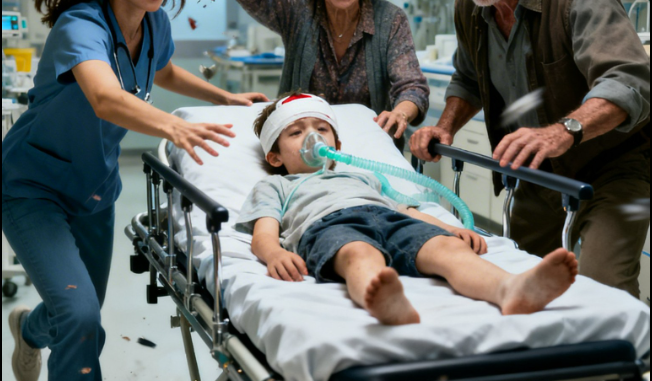
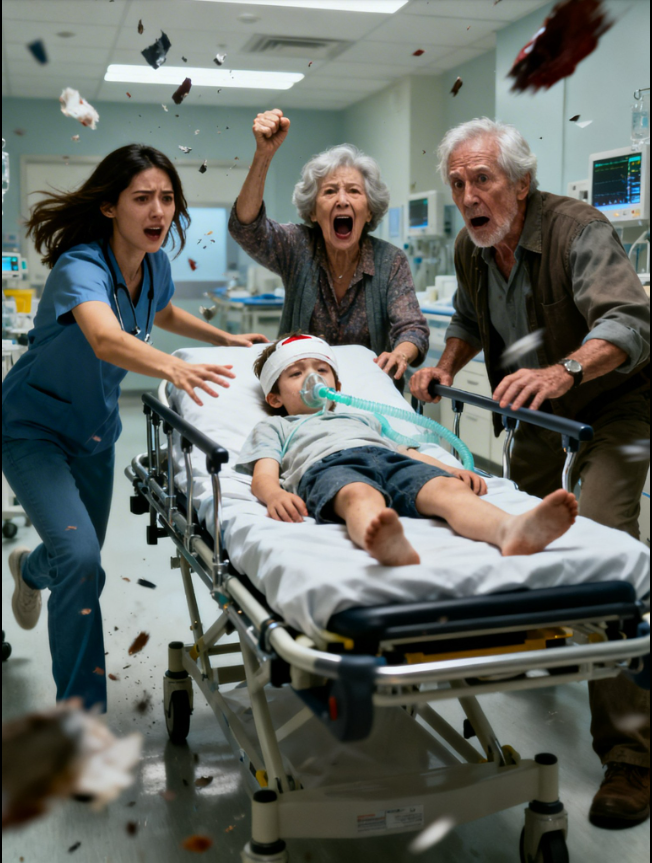
She stepped forward, reached down, and grabbed Emma’s oxygen mask.
For a split second, my brain refused to process it. Like the world couldn’t be that insane.
Then the mask lifted away from Emma’s face.
The monitor beep changed—sharper, faster, angry.
“No!” I lunged, but my mother was already turning, arm swinging with the casual cruelty of someone tossing trash.
The mask hit the wall and clattered to the floor.
Emma’s chest hitched.
The monitor screamed.
I don’t remember the sound I made, but it wasn’t human.
I threw myself over the bed, hands scrambling for the mask, for the tubing, for anything. Emma’s lips looked wrong—too pale, too still.
My mother stood there, breathing fast, eyes wide with something that looked like victory.
“Well,” she said, voice trembling with rage, “she’s no more now. You can join us.”
Time froze.
Those words didn’t belong in a hospital room.
They belonged in a nightmare.
Nurse Patel burst in first, followed by another nurse and a respiratory therapist. They moved like a trained storm—mask back on, oxygen flowing, hands checking lines, someone pushing buttons.
“Ma’am, step back!” Nurse Patel shouted.
My father barked, “This is ridiculous—”
“Security!” the therapist yelled toward the hall.
I was shaking so hard my teeth rattled. My hands hovered over Emma’s chest like I could will her to breathe.
The monitor beep steadied—slowly, mercifully.
Emma’s chest rose again.
Air. Life.
A sob ripped out of me, hot and violent, and I didn’t care who heard.
Security arrived within seconds—two officers in dark uniforms, faces already tense from the alarm.
“What happened?” one demanded.
I pointed at my mother, my voice breaking. “She—she took it off. She threw it. She—”
My mother’s face snapped into a different expression, fast as flipping a switch. “I was trying to help,” she said, sweet as syrup. “My daughter is hysterical.”
The nurse stared at her like she’d grown teeth. “Ma’am, I watched you rip the mask off that child.”
My father stepped forward, outraged. “This is a misunderstanding—”
“Sir,” security said, voice flat, “you need to leave the room.”
My mother’s eyes widened. “You can’t remove us! That’s my granddaughter!”
“You endangered your granddaughter,” Nurse Patel said, shaking with fury. “Get out.”
The security officers moved in. My mother tried to jerk away, but one of them caught her arm firmly. “Ma’am, you need to come with us.”
My mother’s composure shattered. “Megan!” she screamed, twisting toward me. “You did this! You made me do this!”
My father looked at me, face pale now. “Megan, tell them to stop. Tell them this is—”
I stared at him, trembling, my hands still near Emma’s face like I was afraid oxygen might disappear again if I blinked.
And I said, very quietly, “Get out.”
My mother shrieked something about ungrateful daughters and ruined families as security dragged her into the hallway. My father followed, trying to argue, trying to posture, but his voice sounded smaller now—less certain.
The door shut behind them.
The room became an island again: me, my child, and the machines.
Nurse Patel’s expression softened as she checked the monitor. “She’s okay,” she said firmly. “She’s okay. We got it back on fast.”
I sank into the chair beside the bed, my body collapsing like it had been cut loose from its strings.
“I—I should’ve stopped her,” I whispered.
“You did,” Nurse Patel said. “You called it out. We responded. Your daughter is still here.”
I looked at Emma, at the gentle rise of her chest, at the fragile mask resting on her face.
Still here.
A few minutes later, a hospital administrator came in, followed by a police officer. They asked questions. I answered them with a voice that sounded like it belonged to someone else.
Yes, that’s my mother.
Yes, she removed the oxygen mask.
Yes, she threw it.
Yes, I want to press charges.
Saying those words felt like stepping off a cliff.
But then I looked at Emma.
And I knew I didn’t have a choice.
Because love isn’t a transaction.
Love doesn’t come with threats.
Love doesn’t rip air away from a child.
That night, after my parents were escorted out, after security posted someone near Emma’s room, after a social worker sat with me and explained restraining orders in a calm voice, I finally let my head rest on the edge of Emma’s bed.
I whispered stories into the quiet.
About the treehouse.
About pancakes shaped like dinosaurs.
About the way she used to demand “one more song” at bedtime until my voice went hoarse.
And somewhere in the deep hours, when the hospital lights dimmed but never truly went dark, Emma’s fingers moved.
Just a little.
They curled around mine.
I froze, afraid to breathe.
“Emma?” I whispered.
Her eyes didn’t open. But her grip tightened, faint and real.
A sob broke out of me again—this one softer, grateful, wrecked.
“Hi, baby,” I whispered. “I’m right here. I’m not going anywhere.”
In the weeks that followed, the world tried to become normal again, but it couldn’t.
My parents left voicemails that ranged from furious to pleading. My mother’s voice would swing between insults and tears like she thought emotion was a key that could unlock obedience.
I didn’t answer.
I filed the paperwork.
I met with the detective.
I sat in a small courtroom and listened to words like assault and endangerment and restraining order spoken in a tone that made my skin prickle.
My father tried to corner me once in the hallway, eyes bloodshot, voice cracking. “Your mother wasn’t herself,” he said. “She panicked. She—”
“No,” I said, steady. “She did exactly what she wanted to do. She wanted control. She wanted me to break.”
He swallowed hard. “We’re family.”
I looked him in the eyes and said, “Family doesn’t do that.”
Emma stayed in the hospital for a long time. There were scans, therapies, slow improvements that felt like miracles and setbacks that felt like betrayal.
But she came back to me.
Not all at once. Not like a movie ending where the child sits up and laughs.
It was quieter than that.
She opened her eyes and looked at me like she was searching for something familiar.
She whispered “Mommy” with a voice that scraped my soul raw.
She cried when she remembered the fall, and I held her until the shaking stopped.
And then—one day, weeks later—she asked for her stuffed bunny and demanded apple juice like she’d never been gone.
That was the day I finally believed we might survive this.
When we went home, the treehouse stood in the backyard like a ghost. I thought about tearing it down.
But Emma asked to see it.
We walked outside slowly, her steps careful, her hand in mine. She stared up at the wooden platform, the ladder, the railing.
“It tried to hurt me,” she said softly.
My throat tightened. “It was an accident,” I said, even though the word tasted bitter.
She looked at me. “Are we garbage, Mommy?”
The question hit me like a punch—because it wasn’t just about the fall. It was about everything.
It was about the way my mother had looked at us like we were disposable.
I crouched down in front of her and held her face gently between my hands.
“No,” I said. “No, baby. We are not garbage. We are not what they say. We are not what they do.”
Her eyes filled with tears. “Then why were they mad?”
I swallowed, choosing my words like stepping through broken glass.
“Some people,” I said, “think love is something you earn. Something you pay for. Something you lose if you don’t obey.”
Emma sniffled. “That’s silly.”
A laugh broke through my tears, small and real. “It is,” I said. “And we don’t have to play that game.”
I stood, took her hand, and looked at the treehouse again.
Not as a symbol of what went wrong.
But as a place we could make safe again—on our terms.
We didn’t rebuild it right away. We took our time. We added railings, padding, safer steps. We asked for help—from kind neighbors, from people who didn’t demand repayment in obedience.
And when it was finished, Emma climbed one step, then another, then paused.
She looked back at me.
I held out my arms—not to stop her, not to control her, but to remind her she wasn’t alone.
“You’ve got me,” I said.
Emma took a breath and climbed the rest of the way up.
From the platform, she looked out over the yard like she was seeing the world again for the first time.
And for the first time since the fall, since the ICU, since my mother’s hand had ripped air away from my child, I felt something loosen inside my chest.
Not forgiveness.
Not forgetting.
But freedom.
Because my parents had tried to turn my daughter’s life into leverage.
And all they’d done was prove they’d never deserved a place in it.
THE END
Để lại một phản hồi