The first thing I noticed when we pulled up to my parents’ house was the wreath.
It was bigger than last year’s—fat pine branches and glossy red ornaments, a gold ribbon that said GIVE THANKS in looping cursive. It looked like the kind of decoration you’d see in a magazine spread about wholesome American holidays, the kind where nobody’s jaw is clenched while they smile for photos.
My hands tightened around the steering wheel. For a second, I considered making some excuse—stomach bug, car trouble, sudden work call—and driving straight back to our apartment.
Behind me, my son, Mason, kicked his feet against the back of my seat, humming some tune he’d learned in school. My daughter, Sophie, sat in her booster with her knees tucked up, quietly peeling the corner of a sticker off her sweater and pressing it back down again.
arrow_forward_ios
Read morePause
00:00
00:19
01:31Mute
Powered by
GliaStudios
“You okay, Mom?” Sophie asked.
She was six—six going on sixty in the way she watched people’s faces like she was always trying to solve a puzzle. When she asked that question, she wasn’t asking about traffic or the radio.
“I’m fine,” I lied. “Just… holiday nerves.”
Mason leaned forward. “Are we gonna have pie? Grandma said there’d be pie.”
“We’re gonna have pie,” I promised, even though I knew better than to promise anything that depended on my mother’s mood.
I turned off the engine and forced myself to breathe. The air outside had that late-November bite, cold enough to sting the inside of my nose. The sky was pale and overcast, and the neighborhood looked like a postcard—perfect lawns, tidy porches, the faint smell of someone’s fireplace smoke drifting on the wind.
Normal.
Everything about my parents’ house always looked normal from the outside.
I helped Mason out, then Sophie, and we walked up the driveway with the aluminum pan of green bean casserole balanced between my hands. It was the one dish my mother allowed me to bring without criticism—maybe because she didn’t actually like it, so it didn’t matter if I ruined it.
My stomach fluttered as we reached the front door. Before I could knock, it swung open.
My sister, Amanda, stood there in a cream sweater and jeans, holding a glass of wine like it was part of her personality. She smiled so wide it looked painful.
“Well, look who finally made it,” she said, voice sweet as iced tea. “Hi, babies!”
Mason ran in first, already sniffing the air like a bloodhound. Sophie stayed close to my side.
“Hi, Mandy,” I said.
Amanda’s smile flickered. “It’s Amanda,” she corrected, like she always did, even though she’d called me Becca my whole life and never once asked if I preferred Rebecca.
I stepped inside, and the house hit me with warmth and noise. The television was on in the living room—some football game. From the kitchen came the clatter of pots and a strong smell of turkey, butter, and my mother’s signature lemon-sage stuffing.
“Grandma!” Mason yelled, sprinting toward the kitchen.
I followed at a slower pace, Sophie’s hand slipping into mine without a word. Her fingers were cold.
My father was in the dining room, adjusting place settings like he was preparing for a formal dinner party. He looked up and gave me a small nod, the closest he ever got to warmth.
“Hey,” I said.
“Rebecca,” he replied, like my name was a business transaction. “You’re late.”
“It’s two o’clock,” I said. “Dinner’s at four.”
He stared at me for a beat, then went back to straightening forks.
I swallowed my frustration and walked into the kitchen.
My mother was at the counter, hair sprayed into place, apron tied tight around her waist. She glanced over her shoulder when Mason barreled in and wrapped his arms around her legs.
“Grandma! I’m hungry!”
“Oh, honey,” she cooed, instantly softening for him the way she always did—until she saw me. Then her eyes sharpened, like she’d just noticed a stain on the carpet. “Mason, don’t pull. You’ll wrinkle my apron.”
She patted his head anyway, then looked at Sophie.
“And you,” my mother said, tone brisk. “Hello.”
Sophie smiled politely. “Hi, Grandma.”
My mother’s gaze slid to me. “Rebecca.”
“Mom,” I said, setting the casserole down. “Happy Thanksgiving.”
She made a sound that might have been acknowledgement. “Put that over there. And don’t block the counter.”
I moved the dish where she pointed.
It was always like this. The smallest interactions felt like navigating a minefield. If I said the wrong thing, my mother would twist it. If I stayed quiet, she’d accuse me of being rude. If I tried to joke, she’d act like I was embarrassing her.
I’d gotten good at the middle ground—pleasant, neutral, invisible when possible.
But today, something in the air felt… different.
My mother kept checking her phone. My father kept glancing toward the front door like he was waiting for someone. Amanda floated around the house with a restless energy, refilling her wine glass even though it was barely mid-afternoon.
And then there were the other kids.
My cousin’s twins were there—Liam and Lucas—wearing matching sweaters with tiny turkeys on them. My aunt’s daughter had brought her toddler. Kids ran through the hallway, their laughter bouncing off the walls.
At any other family’s Thanksgiving, the chaos would’ve felt comforting. Here, it just made me tense, because chaos meant my mother’s patience would snap sooner.
Sophie stayed near me, watching. Mason darted around like a pinball.
“Mom,” Amanda said at one point, leaning against the fridge. “When are you gonna tell them?”
My mother’s eyes cut toward her. “Not yet.”
My father cleared his throat in the dining room, loud enough to be deliberate.
“Tell us what?” my aunt asked, emerging from the living room with a bowl of chips.
My mother’s smile snapped into place. “Oh, nothing. Just… something we’ve been meaning to share.”
I felt a prickling on the back of my neck. I looked at my father. His face was tight.
Sophie tugged gently on my sleeve. “Mom,” she whispered, “why is Grandma acting weird?”
I lowered my voice. “Probably just stressed about cooking.”
Sophie didn’t look convinced.
Neither was I.
We made it through appetizers with only minor jabs—my mother commenting on how “some people” didn’t dress their kids warmly enough, Amanda asking if I was “still doing that remote job thing,” my father reminding me that I’d once promised to “get my life together” by thirty.
I smiled through it all, because that’s what I’d learned to do. Smile. Nod. Absorb the blows like they were normal.
By three-thirty, the house was full.
My uncle arrived with his girlfriend. My cousin brought a pumpkin roll. Someone turned the football volume up. Kids were everywhere—sprawled on the carpet, chasing each other through the hallway, peeking into the kitchen like tiny predators.
My mother finally clapped her hands sharply.
“Alright,” she announced. “All the children, gather in the living room. We need to tell you a secret.”
The room shifted.
Every kid’s head snapped toward her like she’d flipped a switch. Even the teenagers looked up from their phones.
“A secret?” Liam squealed, already running.
Mason’s eyes went wide. “A secret? Like… a surprise?”
My mother’s smile was strange—tight at the corners. Amanda grinned like she was watching a show.
The kids rushed toward the living room in a stampede. Mason took off with them, and Sophie hesitated only a second before following, her curiosity tugging her forward.
I stayed behind in the kitchen, wiping my hands on a towel, my heart beating faster for reasons I couldn’t name.
Secrets in my family were never good.
My mother stepped out of the kitchen and into the hallway, calling after the kids, “Yes, yes, gather close. Sit down.”
I followed at a distance, drawn by a mix of dread and the need to keep an eye on my kids.
In the living room, the children formed a loose semicircle around my parents’ couch. My father stood near the fireplace, hands clasped like he was about to give a speech at a company meeting.
My mother stood in front of the TV, turning it off with the remote. The sudden silence made the house feel hollow.
“Okay,” she said, voice carrying. “This is for all the kids. We want you to hear it first because… well, you’re the future.”
Kids giggled. Someone shushed someone else. Mason bounced on his knees like he might levitate.
Sophie sat cross-legged on the carpet, looking up attentively.
My mother’s eyes swept the group and then—like a knife turning—landed on Sophie and Mason.
Her expression changed.
“No,” she said sharply. “Not you two.”
The room froze. Even the toddlers went quiet in that eerie way kids do when they sense adult tension.
I blinked, sure I’d misheard. “What?”
My mother pointed with the remote like it was a wand. “Mason and Sophie. You stay back. This is for real family only.”
The words hit the room like a plate shattering.
Sophie’s face went blank, confusion flickering across it like a light struggling to turn on.
Mason looked around, processing the tone before the meaning. “But… I’m your grandson,” he said, voice small.
My mother’s jaw tightened. “Don’t argue. Go stand over there.”
She gestured toward the hallway—away from the circle, away from the secret.
Heat climbed up my neck. “Mom,” I said, stepping forward, “what are you talking about? They are family.”
My father didn’t look at me. He stared at the mantle like the wood grain was fascinating.
Amanda’s lips parted into a smirk that made my skin crawl.
My mother’s voice stayed loud, so everyone could hear it. “This doesn’t concern them.”
My aunt shifted uncomfortably. “Carol… maybe—”
“Stay out of it,” my mother snapped, then looked back at Sophie and Mason. “Now.”
Mason’s eyes filled with tears. He looked at me like I could fix it with one word.
Sophie stood slowly, her small shoulders tensing. She wasn’t crying—not yet. She was trying to understand.
“Grandma,” she said softly, “what secret?”
My mother’s eyes narrowed. “I said it’s not for you.”
Sophie took a step closer anyway, like she couldn’t help herself. She reached out and lightly grabbed the hem of my mother’s dress—just a gentle tug, like a child asking for attention.
“Please,” Sophie said. “I wanna know.”
The next second happened so fast my brain refused to believe it.
My mother jerked backward like Sophie’s touch burned her. Her face twisted—anger, disgust, something raw and ugly—and she lifted her foot.
She kicked.
Not a shove, not a nudge.
A sharp, deliberate kick aimed at Sophie’s torso.
Sophie made a small sound—more surprise than pain at first—as she stumbled back. Her heel caught on a toy someone had left on the carpet, and she toppled sideways.
I screamed her name. “Sophie!”
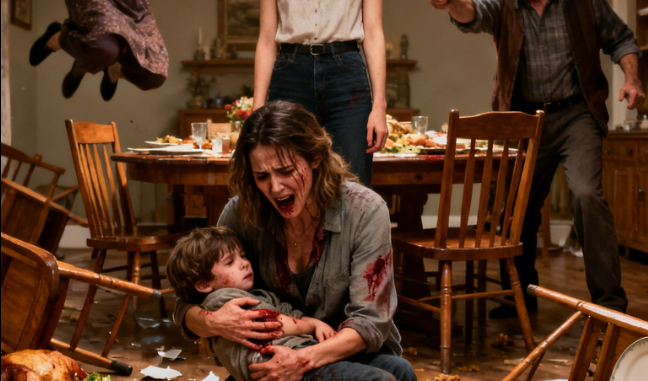
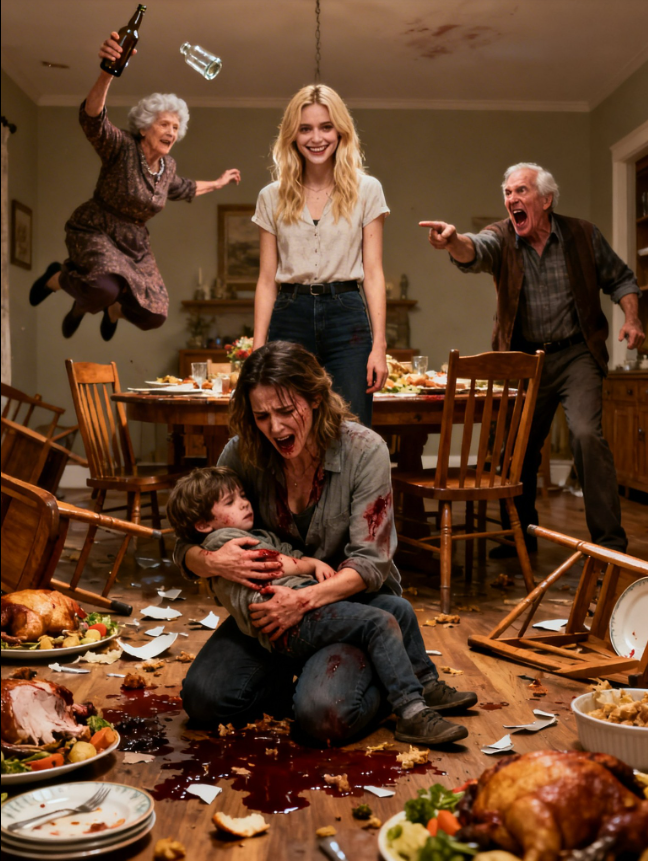
My body surged forward, but my mother was already moving again, fast and furious. Her eyes were wild. She reached down to the coffee table where empty drinks sat—someone’s beer bottle, a glass tumbler, a decorative vase.
Her hand closed around a glass bottle—sparkling cider, I realized in a sick flash, meant for the kids.
“Mom!” I shouted. “Stop!”
She swung her arm like she was pitching a baseball.
The bottle flew.
Time slowed.
Sophie’s eyes widened. She tried to lift her hands, but she was still off balance from the kick. The bottle struck the side of her head with a sound I will never forget—dull, brutal.
Sophie crumpled.
Her body hit the carpet, and she didn’t move.
The room erupted.
Kids started screaming. Someone shouted “Oh my God!” My aunt rushed forward. My uncle grabbed his twins. Mason wailed, a high, terrified sound, as he tried to run to his sister.
I dropped to my knees beside Sophie, my hands shaking so badly I could barely touch her.
“Sophie,” I whispered, then louder, “Sophie! Baby, wake up!”
Her face was pale. Her eyes were closed. There was a swelling bump forming near her temple. A thin line of blood—just enough to make the world tilt—trickled into her hair.
I pressed my fingers to her neck. I felt a pulse.
Thank God.
My chest seized with a sob. “Call 911!” I screamed.
Someone moved—my cousin, I think—fumbling for a phone. My aunt was crying. The toddlers were wailing because everyone else was.
And my mother stood there, breathing hard, still holding the remote, her dress barely swaying from the motion.
For a moment, I looked up at her, waiting for horror, regret, anything human.
She just stared at Sophie like she’d spilled something on the carpet.
“She shouldn’t have touched me,” my mother said, voice flat.
I couldn’t hear. My ears were full of rushing blood.
Mason tried to push past adults to get to Sophie, sobbing, “Sophie! Sophie!”
I grabbed him with one arm while hovering over Sophie with the other, terrified to move her.
My father finally spoke, his voice quiet like he was commenting on weather. “Carol, what did you do?”
My mother snapped at him. “I did what you never do. I handled it.”
Handled it.
Like Sophie was a mess to clean up.
Like my daughter was a problem.
The sirens came faster than I expected. Maybe the dispatcher heard the chaos. Maybe a neighbor called too.
Paramedics pushed through the front door with a stretcher and bags. One knelt beside Sophie, speaking calmly. Another asked me questions, rapid-fire.
“What happened?”
“She got hit—my mother—she threw—” I couldn’t form sentences.
They checked Sophie’s pupils. They stabilized her head. They asked if she’d thrown up. They told me to keep talking to her, even if she couldn’t hear.
I stroked Sophie’s hair, tears dropping onto her forehead. “Sweetheart, it’s Mom. You’re okay. You’re okay. Stay with me.”
Mason clung to my shoulder like he might fall apart.
When the police arrived, my mother finally seemed to realize this wasn’t going to be brushed under the rug.
Two officers entered, scanning the room, their hands near their belts.
“Who called?” one asked.
My cousin raised a trembling hand.
The officer’s eyes landed on Sophie being loaded onto the stretcher. “What happened to the child?”
I stood up so fast my knees nearly buckled. “She—my mother—she kicked her and threw a bottle at her head.”
The officer’s gaze snapped to my mother.
My mother lifted her chin, already rearranging reality in her mind. “That’s not what happened,” she said. “That child attacked me.”
I stared at her, stunned. “She’s six,” I whispered, like maybe pointing out her age would make my mother hear herself.
My mother’s eyes flashed. “She grabbed me.”
The officer looked between us, assessing.
My aunt spoke up through tears. “The little girl just wanted to know the secret. Carol—she—she lost it.”
My mother’s mouth tightened. “Don’t you start.”
The paramedics rolled Sophie out the door. I grabbed my coat with shaking hands.
“I’m going with her,” I said, voice cracking.
Mason sobbed harder. “I wanna go! I wanna go!”
“You are,” I said, scooping him up. “You’re coming with me.”
One of the officers stepped toward my mother. “Ma’am, I need you to stay here.”
My mother’s eyes flicked to the officer’s badge, then to my father, like she expected him to rescue her.
My father didn’t move.
In the driveway, cold air slapped me. Sophie’s small body looked impossibly tiny on the stretcher. The ambulance doors opened like a mouth.
I climbed in with Mason, who was shaking.
As the doors shut, I caught one last glimpse through the window of my mother standing in the doorway, arms crossed.
Not crying.
Not reaching out.
Just watching.
The ride to the hospital felt like a nightmare filmed in shaky camera.
The paramedic kept checking Sophie’s vitals, speaking in that calm, practiced tone that somehow made it worse. Mason kept asking if Sophie was going to die.
“No,” I said, forcing certainty I didn’t feel. “No, baby. She’s going to be okay.”
I called my best friend, Tasha, with trembling hands.
“Tash,” I choked out. “Something happened. Sophie—she—my mom—”
“What?” Tasha’s voice sharpened instantly. “Where are you?”
“On the way to Mercy General. My mom hurt her. She—she threw a bottle.”
There was a pause. “I’m coming,” Tasha said. No questions. Just action.
At the hospital, everything turned into fluorescent lights and clipped voices and paperwork shoved into my hands.
They took Sophie to imaging. They asked me about her allergies. They asked about medications. They asked what happened again and again, like repeating it might make it less real.
Mason sat in a plastic chair, curled into himself, thumb in his mouth, eyes swollen from crying.
I knelt in front of him. “Buddy,” I said softly, “I need you to listen to me. Sophie is with doctors. They’re helping her. Okay?”
He nodded, tears sliding down his cheeks. “Why did Grandma do that?”
The question pierced me.
Why.
I had so many answers—none of them good.
“Grandma… isn’t well,” I said, because I couldn’t tell my son that his grandmother was cruel on purpose. Not yet. Not when he still wanted pie from her.
A social worker appeared, asking to speak with me privately.
My stomach dropped. “Is Sophie—?”
“She’s being evaluated,” the woman said gently. “This is routine when a child is injured. We need to ask a few questions.”
Routine.
Like this happened all the time.
I sat in a small room and answered questions while my hands shook.
“Who caused the injury?”
“My mother.”
“Was anyone else involved?”
“No.”
“Has anything like this happened before?”
I hesitated.
Not like this. Not with a bottle.
But my mother had always had a way of hurting people and making it look like discipline, like “teaching a lesson.” Sharp words. Public shaming. Grabbing Sophie’s wrist too hard when Sophie reached for something. Snapping at Mason until he flinched.
I swallowed. “She’s… been harsh. But nothing like this.”
The social worker’s eyes were kind but serious. “The police may be involved.”
“They already are,” I said, my voice hollow. “They came to the house.”
“Okay,” she said. “We will coordinate. Right now, focus on your daughter.”
Hours passed in fragments.
Tasha arrived, breathless, hair in a messy bun, eyes blazing with anger. She wrapped her arms around me and held on so tight I felt my bones ache.
“I swear to God,” she whispered, “if I ever see your mother again—”
“Tash,” I croaked, and my voice broke.
She pulled back and cupped my face. “Hey. Hey. Look at me. Sophie’s going to be okay. You’re doing everything right.”
I didn’t feel like I was doing anything right. I felt like I’d brought my kids into a lion’s den because I’d spent my whole life hoping the lion might turn into a house cat.
A doctor finally came out, holding a clipboard.
“Rebecca?” he asked.
I stood so fast my chair scraped the floor.
“Sophie has a concussion,” he said, “and a significant hematoma where the bottle impacted. The scans don’t show a skull fracture, and there’s no bleeding in the brain. That’s good news.”
My knees nearly gave out. Relief flooded me so hard I started crying right there, hands over my mouth.
“But,” he continued, “we need to observe her. Concussions can be unpredictable, and with a loss of consciousness, we take it seriously.”
“Can I see her?” I whispered.
He nodded. “She’s waking up. She’s groggy. Keep the room quiet.”
We walked down a hallway to a small room where Sophie lay in a hospital bed, a bandage on her head, her eyelashes fluttering.
My heart squeezed so tight I couldn’t breathe.
I stepped to her side and took her hand. Her fingers were warm now, wrapped in the hospital’s thin blanket.
“Sophie,” I whispered, voice shaking. “Baby, it’s Mom.”
Her eyes opened slowly. She blinked, confused.
“Mom?” she murmured.
“I’m here,” I said, tears spilling. “I’m right here.”
Her brows knit. “My head hurts.”
“I know,” I whispered. “I’m so sorry.”
She looked around, trying to piece it together. Then her gaze landed on Mason standing behind me, eyes wide.
“Mase,” she said softly.
Mason rushed forward and grabbed her other hand, sobbing. “Don’t go to sleep forever!”
Sophie looked startled, then tried to smile, which made her wince.
“I’m not,” she whispered.
I pressed my forehead to her hand and breathed.
She was alive.
She was here.
And something inside me—something that had been bending for thirty-two years—finally snapped into a clean break.
While Sophie slept, the police came to the hospital.
An officer sat with me and took my statement. I told him everything, from the moment my mother said “real family only” to the kick to the bottle.
His expression grew darker with each detail.
“Were there witnesses?” he asked.
“Yes,” I said. “Everyone. Kids, adults. My aunt. My cousin.”
He nodded. “We’ll be speaking to them. Your mother has been detained for questioning.”
Detained.
The word felt surreal. Like my mother belonged in a different category than people who get detained.
“What about my father?” I asked, though I didn’t know why.
The officer’s lips pressed together. “We’ll assess everyone’s role. Right now, our focus is on the child’s safety.”
Child’s safety.
Like it wasn’t obvious who the danger was.
When the officer left, Tasha sat beside me, her hand on my shoulder.
“She’s done,” Tasha said. “You hear me? She’s done. No more chances.”
I stared at Sophie’s sleeping face, pale under the hospital light.
No more chances.
That should have been easy.
But family has a way of hooking into you like barbed wire. Even when it’s toxic, even when it hurts, you’re trained to pull it closer instead of ripping it out.
Still, I remembered my mother’s face when Sophie fell.
Not shock.
Not regret.
Just irritation.
And I knew—deep in a place beyond reasoning—that if I went back, if I let my mother back into our lives, she would do it again. Maybe not with a bottle. Maybe with words. Maybe with something quieter.
But she would hurt my kids to punish me.
Because that’s what she’d always done. Hurt me in ways that looked like love from the outside.
That night, I didn’t sleep. I sat in the hospital chair, watching Sophie’s chest rise and fall, while Mason dozed curled against Tasha on a couch.
I thought about every Thanksgiving before this one.
The ones where my mother complained about my hair. The ones where she compared me to Amanda, loudly and casually, like I wasn’t sitting right there. The ones where she reminded everyone how I’d “made mistakes” by having kids before marriage, by leaving a job she didn’t approve of, by choosing a life that didn’t fit her script.
I’d kept coming back because I wanted my kids to have grandparents. Cousins. Traditions. Because I wanted to believe my mother could love them even if she didn’t love me.
But love doesn’t kick a child.
Love doesn’t throw a bottle.
In the morning, Sophie woke up more alert. She asked for apple juice. She asked why she was at the hospital.
I took a deep breath and told her the simplest truth I could.
“You got hurt,” I said softly. “And we came here so doctors could help you.”
Sophie frowned. “Grandma hurt me.”
My throat tightened. “Yes,” I admitted, voice shaking. “Grandma did something very wrong.”
Sophie stared at me, eyes too old for her face. “Did I do something bad?”
“No,” I said immediately, gripping her hand. “No, sweetheart. You did nothing bad. You asked a question. That’s all.”
Her lower lip trembled. “She said I’m not real family.”
Rage flared in my chest so hot it made me dizzy.
I leaned close. “Listen to me,” I said, voice firm. “You are my family. You are Mason’s family. You are real, and you belong. Grandma said something cruel because she was being cruel. It wasn’t true.”
Sophie’s eyes filled. “Then why did she say it?”
Because she wanted to hurt us.
Because she needed control.
Because she didn’t know how to love without conditions.
But I couldn’t put that weight on a six-year-old.
“Sometimes grown-ups say things when they’re angry,” I said carefully, “and it’s wrong. And there are consequences.”
“What’s con-se-quen-ces?” Sophie asked.
I swallowed. “It means… when you do something bad, you have to face what happens next.”
Two days later, Sophie was discharged with instructions: rest, no screens, check for symptoms, follow-up with a pediatric neurologist.
I carried her out of the hospital like she was made of glass. Mason held her backpack, solemn and quiet, like he’d grown five years older in forty-eight hours.
Outside, the air was cold and bright. Cars passed. People walked by with coffees. The world kept moving like nothing had happened.
But I was not the same person who had walked into my parents’ house with a casserole dish.
At home, I tucked Sophie into bed. She wanted the hallway light on. She wanted the door cracked. She wanted me to sit beside her until she fell asleep.
Mason crawled into my lap on the couch later, his small body heavy with exhaustion.
“Are we gonna see Grandma again?” he asked, voice muffled against my shirt.
I looked at my son—his soft hair, his wide eyes—and made the choice I should’ve made years ago.
“No,” I said. “We’re not.”
He pulled back, confused. “But… she’s Grandma.”
“I know,” I said, forcing my voice steady. “But she hurt Sophie. And my job is to keep you safe. So we won’t go back.”
Mason’s face crumpled. He didn’t understand all of it, but he understood enough to feel loss.
He cried quietly, and I held him, and I let him grieve. Because grief was real even when what you were losing wasn’t healthy.
A week later, a detective called to tell me my mother had been charged.
Assault on a child. Endangerment. Something else, words that sounded like legal thunder.
My hands shook as I held the phone.
Amanda texted me that same day.
You’ve ruined this family.
I stared at the screen until the letters blurred.
Then I blocked her.
My father called two days after that.
I let it go to voicemail, but he left a message anyway, his voice tight and controlled.
“Rebecca,” he said, “your mother is… distraught. She didn’t mean for it to happen like that. We can discuss this as adults. Call me.”
Discuss it.
As adults.
Like Sophie’s small unconscious body on the carpet was just a misunderstanding.
I didn’t call back.
Instead, I sat at my kitchen table with a stack of papers from the court and filed for a protective order.
The judge granted it the same day.
No contact.
No visits.
No calls.
No “accidental” run-ins.
I should’ve felt triumph. Instead, I felt something like mourning.
Not for my mother.
For the fantasy that she could ever be who I needed her to be.
The court process took months.
There were interviews, statements, hearings. Witnesses gave accounts—my aunt confirming the kick, my cousin describing the bottle, even my father admitting, reluctantly, that my mother had thrown it.
My mother’s lawyer tried to paint Sophie as “out of control,” tried to suggest the bottle was “an accident,” tried to twist it into something less monstrous.
But the truth was heavy. It didn’t twist easily.
My mother never apologized—not once.
When I saw her in court, she looked at me like I was the criminal. Like I was the one who had betrayed her.
Amanda sat behind her, glaring at me like I’d set the whole thing up for attention.
My father sat beside them, hands clasped, eyes down.
And Sophie sat beside me, holding a small stuffed rabbit, her other hand in mine.
The judge spoke about accountability. About harm. About the seriousness of violence against a child.
My mother’s face stayed cold.
When the sentence came—probation with strict conditions, mandatory counseling, no contact—my mother finally reacted.
Not with remorse.
With outrage.
“This is ridiculous,” she snapped, loud enough that the courtroom hushed. “She’s my granddaughter!”
The judge’s gaze hardened. “Your granddaughter,” he repeated, “whom you injured.”
My mother’s mouth tightened, and she looked at me like she’d never hated anyone more.
For a second, that old reflex sparked in me—the instinct to shrink, to apologize, to make peace.
Then Sophie squeezed my hand.
And the reflex died.
After court, we walked out into the sunlight, and I realized something strange.
The air felt lighter.
Not because what happened was gone—it wasn’t. Sophie still had nightmares. Mason still flinched when someone raised their voice. I still woke up some nights with the sound of glass hitting bone echoing in my head.
But the constant pressure—the expectation to keep enduring, to keep returning, to keep pretending—was gone.
I didn’t have to go back.
I didn’t have to beg for crumbs of love at a table that had never had a seat for me.
That next Thanksgiving, it was just the three of us—and Tasha, because she refused to let us spend it alone.
We made a small turkey in my tiny oven. Mason helped stir the mashed potatoes. Sophie arranged paper leaves she’d made at school across the table.
There was laughter. Real laughter. The kind that didn’t hide teeth.
At one point, Mason asked, “Do you think Grandma’s mad?”
I glanced at Sophie, who was carefully coloring a turkey on her placemat.
“Maybe,” I said honestly. “But that’s not our problem.”
Sophie looked up. Her eyes were steadier than they’d been in months. “We’re real family,” she said, like she was declaring a fact to the universe.
I smiled, throat tight. “Yes,” I said. “We are.”
Tasha raised her glass of sparkling cider. “To real family,” she said.
Mason lifted his juice box like it was champagne. Sophie lifted her water cup.
And I lifted my glass too, feeling something settle in my chest—not peace, exactly, but certainty.
My mother’s secret had been meant to exclude us, to remind us we didn’t belong.
Instead, it had done the opposite.
It had forced me to stop chasing a place at a table that was never mine.
It had made me build my own.
And as my kids laughed and the turkey browned and the apartment filled with warmth, I realized the clearest ending I could’ve ever asked for:
We didn’t need their definition of family.
We already had the real thing.
THE END
Để lại một phản hồi