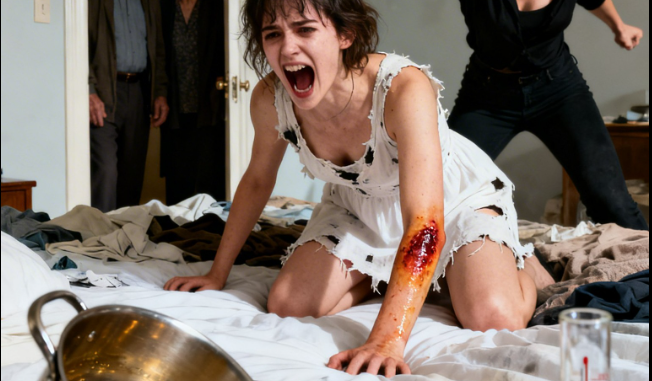

She Called It a “Simple Prank”—But Boiling Oil, a Broken Jaw, and One Nurse Changed Everything Forever
I couldn’t talk.
Not really.
My jaw was wrapped tight, swollen and aching in a way that made the whole left side of my face feel like it belonged to someone else. Every breath scraped through my throat like sand. My arms were covered in thick white bandages that made me look like a mannequin someone had tried to fix with gauze and tape.
The hospital room smelled like disinfectant and warm plastic. A heart monitor clicked and beeped beside me, steady as a metronome, like it was keeping time for my pain.
When my parents finally walked in, I tried to lift my head. The movement sent a hot stab through my cheekbone and down my neck.
Mom’s eyes went straight to my bandaged arms. Dad’s gaze flicked to the bruising around my jaw.
For half a second, I thought—really thought—they’re going to see it now.
That they’d look at me, their oldest daughter, and feel something sharp and protective. That they’d stop excusing what they always excused.
Then my sister, Kenzie, sauntered in behind them and laughed.
A bright, careless sound—like she’d stepped into a movie theater late and found her friends already seated.
“Oh my God,” she said, hand to her chest like she couldn’t breathe from amusement. “She’s being dramatic about a simple prank!”
The words hit harder than any fist.
Mom turned her head, confused. “Kenzie, what happened to Harper?”
My name—Harper—hung in the air, fragile and hopeful.
Kenzie rolled her eyes. “I was making fries. The oil splashed. She freaked out. Then she—” She pointed at my face like she was accusing me of bad acting. “—started screaming like I set the house on fire. I tried to calm her down and she flailed, and… I don’t know, she must’ve hit her face on something. It was chaos.”
Dad’s expression tightened into the familiar line: irritation disguised as concern. “Harper,” he said, in the tone he used when I was eight and cried because Kenzie broke my toy, “you’ve got to stop overreacting.”
I stared at them.
I tried to say she poured it on me while I slept.
I tried to say she punched me when I screamed.
All that came out was a wet, muffled sound, trapped behind swelling and tape.
Kenzie grinned, like she’d won a round in a game only she understood.
A nurse stepped into the room at that moment. Her badge read NORA LANGLEY, RN. She was in her forties, hair pulled into a neat bun, calm eyes that didn’t dart away when they saw pain.
“Good afternoon,” Nora said, glancing from my parents to my sister, then to me.
Kenzie’s smile sharpened. “Hi! So sorry my sister’s taking up a bed over a tiny accident.”
Nora didn’t smile back. She walked to my bedside, adjusted the IV line with practiced hands, and leaned close enough that her voice dropped under the steady beep.
“Harper,” she said gently, “can you write?”
I blinked once. Hard.
Nora slid a clipboard onto my lap and put a pen between my fingers like she’d done it a thousand times.
My hands shook. My arms burned under the bandages, a deep ache like I’d been branded.
But the pen moved.
SHE POURED BOILING OIL ON ME WHILE I SLEPT. THEN PUNCHED ME.
The letters came out jagged and uneven. Tears splashed onto the page before I realized my eyes had started leaking.
Nora’s gaze didn’t widen dramatically. She didn’t gasp.
She just read it—slowly, carefully—then lifted her eyes to mine.
“Okay,” she said, voice low and steady. “Thank you. I believe you.”
Behind her, my mother was talking, her voice rising. “Harper, honey, what did you write? Let me—”
Nora shifted her body so the clipboard was angled away. A small move. A protective one.
Dad took a step forward, frowning. “What’s going on?”
Kenzie’s laugh turned brittle. “Oh my God. She’s lying. She’s always—”
Nora held up one finger without looking at her. Like enough.
Then she turned toward my parents with the kind of professional politeness that carried steel underneath.
“I need to ask everyone to step out,” Nora said. “Now.”
Mom blinked. “Excuse me? That’s my daughter.”
“And this is my patient,” Nora replied. “I need to do an assessment without distractions.”
Kenzie scoffed, but Dad’s eyes narrowed. “We’re not going anywhere.”
Nora met his gaze. “Sir, if you refuse, I’ll call security.”
The room went quiet in a way that made my skin crawl.
Kenzie’s eyes flicked to my clipboard, then back to Nora. Her smile didn’t reach her eyes anymore.
“Fine,” Mom said quickly, tugging at Dad’s sleeve. “Let’s just step out. We can talk afterward.”
Kenzie hesitated like she couldn’t believe the rules applied to her. Then she shrugged and turned toward the door.
As she passed my bed, she leaned in, voice sugary and low.
“Nice try,” she whispered. “But they always pick me.”
Nora watched her go like she was memorizing her.
When the door clicked shut, my whole body sagged into the mattress. I wanted to curl into myself, but I couldn’t. My arms were too stiff with bandages. My jaw throbbed with every heartbeat.
Nora sat on the edge of the chair beside my bed, picked up the clipboard again, and spoke softly.
“Harper, I’m going to ask you a few questions. Nod if you understand.”
I nodded.
“Did your sister intentionally pour hot oil on you?”
I nodded harder, tears spilling again.
“Were you asleep when it happened?”
I nodded.
“Did she strike you afterward?”
I nodded, and my throat tightened until breathing felt like work.
Nora exhaled through her nose, the way someone does when they’re trying to stay calm while their insides rage.
“Okay,” she said. “I’m calling the charge nurse, the social worker, and hospital security. And I’m asking you if you want police involved.”
My pulse kicked.
Yes.
I wrote it again, big and shaky.
YES. PLEASE.
Nora covered my hand gently with hers for a second. “Okay,” she said. “You’re not alone in this. Not anymore.”
Earlier that night, I’d been stupid enough to think going home would be safe.
I’d been staying at my parents’ place for a few weeks while my apartment lease turned over. It was temporary. Inconvenient, but temporary—like sleeping in my childhood room, surrounded by old yearbooks and the faint smell of laundry detergent.
Kenzie had moved back in too. Again.
She called it “saving money.” My parents called it “helping family.”
I called it what it was: Kenzie failing upward, landing softly because Mom and Dad always laid out a cushion for her.
That evening, Mom had made meatloaf. Dad had watched football. Kenzie had sat on the couch scrolling through videos on her phone, laughing at things that didn’t seem funny.
I’d washed the dishes because that’s what I always did when I wanted the night to end peacefully.
Kenzie followed me into the kitchen and leaned against the counter.
“Still playing martyr?” she asked, eyes on my hands in the sink.
I kept my tone neutral. “Just helping.”
She smirked. “You’re so boring.”
I didn’t answer. With Kenzie, answering was always an invitation.
Later, I went to bed early. I’d been exhausted from moving boxes and job stress, and my head hurt in that dull, constant way it had lately.
I fell asleep to the sound of laughter drifting from the living room—Kenzie’s laugh, too loud, too sharp—like someone cracking open a soda can over and over.
I don’t know how long I slept before the pain dragged me out.
At first, it was heat—impossible, sudden—like my skin had been shoved too close to an open flame.
Then it was the sting, the shock, the animal panic.
I jerked awake, and the world snapped into chaos: my bedroom lamp glowing, my sheets half-twisted, my arms on fire under my own flailing hands.
And Kenzie.
Standing beside my bed with a metal pot tilted forward.
Oil glimmered under the lamp light—thick, shimmering, wrong.
My scream tore out of me before I could stop it.
Kenzie’s face was lit with excitement. Not surprise. Not regret.
Excitement.
“Oh my God,” she squealed, like this was a prank on a sitcom. “It worked!”
I tried to shove away from her, but my arms burned when they moved, and I couldn’t think. I couldn’t do anything but scream.
That’s when her expression changed.
Like my pain had ruined her fun.
“Shut up,” she snapped.
I tried to scramble off the bed. I tried to get to the door.
Kenzie stepped in front of me and punched me in the face.
Hard.
A burst of white went off behind my eyes.
I stumbled, hit the dresser, and slid to the floor, the side of my jaw screaming with a new kind of agony—deep and grinding.
I made another sound, smaller this time. A choking sob.
Kenzie stood over me, breathing fast. Her eyes looked wild, but her mouth curled upward.
“Stop making it a thing,” she hissed. “It was a prank.”
Then footsteps thundered down the hall.
My parents’ door opened. The hallway light flicked on, flooding the scene with harsh brightness.
Mom rushed in first, robe tied tight, hair messy. Dad was behind her, eyes already narrowed.
“What is going on?” Mom demanded.
Kenzie turned instantly, like she’d been waiting for an audience. “Harper freaked out,” she said, pointing at me on the floor. “I was cooking and the oil splashed. She started screaming and—look—she’s being crazy.”
Mom’s face crumpled with concern. “Harper?”
I tried to speak, but my jaw shifted wrong and pain detonated.
Dad looked at Kenzie. “Are you okay?”
That question—are you okay—was the moment something inside me went quiet.
Kenzie blinked sweetly. “I’m fine. She’s just… you know how she is.”
Mom moved toward me, eyes widening at my arms. “Oh my God—”
Kenzie cut her off fast. “It’s not that bad. She’s exaggerating.”
Dad’s gaze slid over my arms, then away, like he didn’t want to see.
“Harper,” he said sharply. “Stop screaming. You’re going to wake the neighbors.”
I stared at him from the floor, my skin burning, my face throbbing, and understood: even in the middle of the worst moment of my life, he still cared more about what people might hear.
A neighbor did hear anyway.
Because ten minutes later, as Mom finally fumbled for her keys and Dad muttered about “overreacting,” there was pounding at the front door and a voice yelling, “Everything okay in there?”
Kenzie’s face went tight.
Dad opened the door to Mr. Dalton from across the street, still in his pajama pants.
“I heard screaming,” Mr. Dalton said, eyes wide. “Sounded like someone was hurt.”
Dad forced a laugh. “Just a little kitchen accident. It’s handled.”
Mr. Dalton glanced past him into the hallway—and saw me on the floor. Saw the bandages Mom had started wrapping with a roll from the bathroom cabinet. Saw my face, my jaw misaligned.
His expression changed. “I’m calling an ambulance.”
“It’s not necessary,” Dad snapped.
“It is,” Mr. Dalton said, already pulling out his phone.
Kenzie stepped back, sudden fear flashing in her eyes. She’d wanted an audience. Just not this kind.
That’s how I ended up here—hospital bed, cracked jaw, arms bandaged, sister laughing in my parents’ wake like she’d pulled a harmless prank with a whoopee cushion.
And now, for the first time in my life, someone in authority had looked at me and believed me without hesitation.
Security arrived before my parents came back.
Two hospital guards stood near the door while Nora stepped into the hallway to speak with the charge nurse.
A social worker introduced herself as Ms. Patel, calm and composed, holding a folder.
“Harper,” she said, sitting down close, “you’re safe here. No one can remove you from this hospital against your will. If anyone makes you feel unsafe, we’ll respond immediately.”
I nodded, the relief in my chest so sharp it hurt.
When the police showed up, my mother started crying in the hallway.
I could hear her through the door.
“This is ridiculous,” Dad said, voice angry and low. “We don’t need the police. This is a family issue.”
“That’s my sister,” Mom sobbed. “Kenzie wouldn’t do that. She’s just… she’s impulsive.”
Then Kenzie’s voice, louder than both.
“She’s lying! She’s always jealous! She’s trying to ruin my life!”
The officer who came in was a woman with a tight bun and a steady gaze. Officer Renee Alvarez, her nameplate said.
She pulled up a chair and spoke to me directly, not to my parents.
“Harper,” she said, “I’m going to ask questions. If you can’t speak, you can write or nod. Okay?”
I nodded.
She asked what happened. I wrote it all, hands shaking, tears dripping onto the paper.
Kenzie poured oil. I was asleep. She punched me. Parents saw. Parents minimized. Neighbor called 911.
Officer Alvarez read my words, then looked at Nora. “Photos and documentation?”
Nora nodded. “All charted. The attending physician believes the injuries are consistent with assault.”
Officer Alvarez’s jaw clenched. She stood and walked to the door, opening it just enough to speak into the hallway.
“Ma’am,” she called out, “Kenzie, I need you to come speak with me.”
“I didn’t do anything!” Kenzie yelled back.
Officer Alvarez’s voice stayed calm. “Come speak with me anyway.”
Kenzie stormed into the room with my parents behind her, eyes bright with outrage. She looked like she’d practiced being offended in the mirror.
Officer Alvarez held up a hand. “Just Kenzie.”
Mom protested. “She shouldn’t be alone—”
Officer Alvarez cut her off. “She can handle a conversation.”
Kenzie stepped forward and crossed her arms. “This is insane.”
Officer Alvarez didn’t argue. She didn’t yell. She just asked, “Tell me what happened.”
Kenzie launched into her story again—oil splashed, Harper screamed, Harper flailed, Harper fell, Harper’s dramatic, Harper’s jealous.
While she talked, Officer Alvarez watched her hands, her face, her breathing. Like she was listening to more than words.
Then Alvarez asked, “Were you holding the pot when the oil ‘splashed’?”
Kenzie hesitated. “Yeah.”
“How much oil?”
“I don’t know,” Kenzie snapped. “Enough to cook fries? Why does it matter?”
Officer Alvarez’s tone didn’t change. “Where is the pot now?”
“At home,” Kenzie said.
“Where were you standing when it happened?”
Kenzie pointed vaguely. “In the kitchen. She was… around.”
Officer Alvarez nodded slowly, then asked, “If Harper was asleep, how did it splash on her arms in bed?”
Kenzie’s eyes widened just a fraction—tiny, but enough.
“She—she wasn’t asleep,” Kenzie snapped. “She was half-asleep. She’s always—”
Officer Alvarez lifted the clipboard with my handwriting. She held it up.
“Harper wrote that you poured it on her while she slept.”
Kenzie’s laugh came out too loud. “She’s making it up.”
Officer Alvarez’s gaze stayed steady. “A neighbor called 911 because of screaming. Hospital staff documented a fractured jaw. You’re saying she got a fractured jaw from flailing during a ‘splash’?”
Kenzie’s cheeks reddened. “She probably hit herself.”
Officer Alvarez paused for a moment, then said, “Okay.”
Just okay.
Then she turned to my parents.
“Sir, ma’am,” she said, “I need to speak with Mr. Dalton, the neighbor, and I need to go to the residence. This will be investigated as an assault.”
Dad’s voice rose. “You can’t—”
Officer Alvarez cut him off cleanly. “I can. And I will.”
Kenzie’s face shifted from outrage to something else. Fear, maybe. Not for me—for herself.
She pointed at me, her voice turning sharp and hateful. “You’re doing this because you’ve always hated me.”
I stared back at her.
For years, I’d tried to keep things smooth. I’d swallowed insults at Thanksgiving. I’d let her “borrow” clothes and money and time. I’d listened to my parents’ endless excuses: Kenzie’s just sensitive. Kenzie’s going through a lot. Be the bigger person.
In that hospital bed, with my jaw aching and my arms wrapped like a warning sign, I realized being the bigger person had just been a slow way of disappearing.
I lifted the pen again and wrote one more line, slow and deliberate, so she could see it.
NO. I’M DOING THIS BECAUSE YOU HURT ME.
Kenzie read it, and something in her eyes turned cold.
Then she leaned in and whispered, almost tenderly, “You’ll regret this.”
Officer Alvarez’s voice snapped like a whip. “Kenzie. Back up.”
Kenzie straightened, her face smoothing again into performance.
Mom cried harder. Dad looked furious—at me.
But Officer Alvarez wasn’t looking at them. She was looking at Kenzie like she’d already decided who she was.
That night, while the hospital kept me for observation, Ms. Patel helped me file for an emergency protective order.
Nora checked on me every hour, and each time, she asked, “Are you safe? Do you need anything?”
No one had ever asked me that in my parents’ house.
Jake came too—my boyfriend, the one my parents tolerated because he was polite and steady and didn’t rise to their games. He walked into the room, saw my bandaged arms and swollen face, and his expression shattered.
“Oh, Harper,” he whispered.
I tried to speak. The sound came out mangled.
Jake swallowed hard, eyes wet. “Don’t. Don’t try.”
He held my unbandaged hand carefully. “I’m here.”
When I wrote what happened, his face went pale with rage.
“I’m going to your parents’ house,” he said.
Nora’s voice was firm. “No, you’re not. Police are handling it.”
Jake exhaled and nodded, jaw tight. “Okay. Okay.”
Then he looked at me. “We’re done with them,” he said, like he was making a vow. “Whatever you need—no contact, restraining order, moving—whatever. I’m with you.”
The next morning, Officer Alvarez returned.
“We went to the house,” she said. “Your neighbor provided a statement. He also has a doorbell camera. It captured audio and partial footage from the open hallway when your parents had the front door open.”
My heart pounded.
“What did it—” I tried to say, but pain stopped me.
I wrote: WHAT DID IT SHOW?
Officer Alvarez’s expression was grim. “It shows your sister coming out of the kitchen with a pot shortly before your scream. It captures her saying, ‘Stop making it a thing—it was a prank,’ right after.”
Kenzie’s exact words. The ones she’d hissed at me while I sat on the floor, burning.
Proof.
Officer Alvarez continued, “It also shows your father telling the neighbor it was ‘handled’ while you were on the floor.”
A slow, heavy shame moved through me—less for them than for the years I’d spent expecting them to change.
Officer Alvarez watched my face. “Harper, do you want to press charges?”
I didn’t hesitate. I wrote it in big letters.
YES.
She nodded once. “Okay. We’re arresting her for aggravated assault. Your statement, the medical evidence, and the video are enough to proceed.”
My breath shook on the way out.
For the first time since I was a kid, I felt something I hadn’t felt around my family in years.
Power.
Not the power to hurt someone back—God, I didn’t want that.
The power to say: No. You don’t get to do this and call it a prank.
Kenzie was arrested that afternoon.
Jake and I didn’t go to watch. I didn’t need to see her in handcuffs to believe this was real.
But my mother called my phone anyway—over and over until Jake finally answered and put it on speaker.
“Harper!” Mom cried. “Please tell them to stop. She’s your sister!”
Jake’s voice was ice. “Your other daughter is in the hospital with burns and a fractured jaw.”
Mom sobbed harder. “Kenzie didn’t mean it! She was joking! She’s just impulsive!”
I grabbed the phone with shaking hands and held it close enough to speak softly through my swollen jaw.
“She poured it on me,” I rasped.
Mom’s breath hitched, like the sound surprised her. “Honey, you sound—oh, honey—”
“I was asleep,” I forced out. Each word hurt. “She punched me.”
Silence.
Then Dad’s voice, suddenly on the line, sharp and angry. “So you’re really doing this. You’re sending your sister to jail.”
My vision blurred with tears I refused to let fall.
“No,” I whispered. “She did.”
Dad exhaled in disgust. “You always do this. You always make everything bigger than it is.”
Kenzie shouted something in the background—muffled, furious.
Then the call disconnected.
Jake took the phone from my hand and set it down gently, like it might explode.
He looked at me. “That’s it,” he said. “No more.”
The weeks that followed were a blur of healing and paperwork.
My jaw healed slowly. My arms itched under bandages as new skin formed, tender and tight. Physical therapy helped me move without flinching.
But the real healing was the word no.
No contact. No visits. No “family meetings.” No apologies shaped like blame.
The prosecutor called it what it was: an assault.
Kenzie’s attorney tried to call it a misunderstanding.
A “prank that went too far.”
The judge didn’t smile.
When the video played in court—Kenzie’s voice saying, It was a prank—there was no charm left in it. No laughter.
Just cruelty.
My parents sat behind her in the courtroom like loyal fans at a game, faces tight with anger at the world for not letting them rewrite reality.
When it was my turn to speak, I stood at the podium with my jaw still tender, my arms still marked.
I didn’t tell every story from childhood. I didn’t list every little humiliation.
I only said what mattered.
“I was asleep,” I said, voice steady. “I woke up burning. She hit me when I screamed. And then she laughed about it.”
Kenzie stared at me like she couldn’t believe I’d stopped playing my role.
The judge sentenced her to state prison time for aggravated assault, plus a no-contact order and mandatory counseling during incarceration and release.
It wasn’t the end of her. People survive prison. People change—sometimes.
But it was the end of her access to me.
My parents tried once more.
A handwritten letter arrived at Jake’s place because we’d moved—quietly, quickly—into a new apartment across town. No forwarding address on our old place. New locks. New routines.
The letter said my mother “forgave” me.
It said my father was “disappointed.”
It said Kenzie “still loved me.”
Jake read it, jaw tight, and asked what I wanted to do.
I took the paper, held it for a long moment, and felt nothing but a tired clarity.
Then I tore it in half.
And in half again.
And again.
I threw it in the trash.
Months later, on an ordinary Saturday morning, Jake made pancakes while I sat at our small kitchen table with coffee and sunlight spilling across the wood.
It was the kind of morning I’d never had at my parents’ house—quiet, safe, uncomplicated.
My arms were still marked, faintly, but the pain was gone. My jaw ached sometimes in cold weather, a reminder that my body remembered even when my mind tried to forget.
A notification popped up on my phone: Unknown Number.
I stared at it. My stomach tightened automatically.
Jake glanced at me. “You okay?”
I exhaled slowly. “Yeah.”
I opened the message.
It was one line.
You ruined my life.
No name. No signature.
But I knew.
Kenzie still wanted to make herself the victim in the story where she poured boiling oil on someone in their sleep.
I set the phone down and looked out the window at the street below—kids riding bikes, a dog barking, someone carrying groceries like the world was normal.
Jake slid a plate of pancakes in front of me. “Want me to block it?”
I picked up my fork. “Already done.”
He watched me for a second, then nodded like he understood something important: that I wasn’t asking for permission anymore. I was choosing my life.
I took a bite of pancake. Sweet, warm, ordinary.
And for the first time in longer than I could remember, I felt fully awake without fear.
Because I finally understood the truth I’d spent years trying not to see:
My sister didn’t just hurt me.
My parents helped her.
And I didn’t owe any of them my silence.
I owed myself peace.
I owed myself safety.
I owed myself a life where “prank” didn’t mean pain.
Jake poured more coffee and clinked his mug lightly against mine, like a quiet toast.
“To new chapters,” he said.
I lifted my mug. “To new chapters.”
And when the sun climbed higher, warming the room like a promise, I let myself believe it.
THE END
Để lại một phản hồi