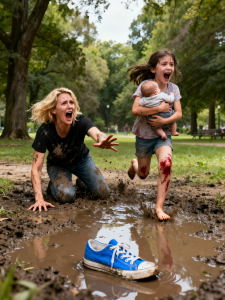
I Left My Kids With My Parents for “Safety”—Then Found My 7-Year-Old Bloody and Barefoot in the Woods, Refusing to Drop Her Baby Brother

As soon as I came back from work, I saw her.
At first my brain wouldn’t accept what my eyes were telling it—because it didn’t fit the shape of any normal afternoon.
My seven-year-old daughter, Lily, was coming out of the tree line behind our house like a small, haunted thing. She was carrying her baby brother in both arms, pressed tight to her chest the way she held her favorite stuffed rabbit when she was scared. Her clothes were torn like she’d been dragged through brambles. Her bare feet were smeared with mud and blood. Cuts striped her forearms in red lines, and her hair was matted with leaves. She was shaking so hard her knees looked like they might fold, but she wouldn’t—wouldn’t—put him down.
The baby, Noah, was quiet in that eerie way that makes your heart stop. Not sleeping-peaceful. Quiet like he’d learned to disappear.
I dropped my purse on the driveway so fast it hit the concrete and spilled everything—keys, receipts, a lipstick I hadn’t used in months. I didn’t care. I ran.
“Lily!” My voice cracked on her name. “Baby—oh my God—Lily!”
Her eyes found mine and widened like she’d been holding her breath for years. Her lips were dry and cracked, and when she tried to speak nothing came out at first, just a rasp. She swayed, tightened her grip on Noah, and took another step like she was marching through fire.
I reached her and caught her shoulders, trying to steady her without jostling the baby. She smelled like dirt and sap and fear. Her skin was hot, and when I touched her arms my fingers came away sticky with dried blood.
“Sweetheart,” I said, trying to keep my voice calm even as my chest threatened to split open. “You’re okay. You’re here. I’ve got you. What happened? Who did this to you?”
Lily’s gaze dropped to Noah. Her arms clenched harder. She shook her head once, fiercely.
“No,” she whispered.
“No what?” I asked, panicked. “No, you’re not okay? No, you can’t tell me? Lily, honey—please.”
She swallowed, lips trembling. “I can’t… I can’t put him down.”
The way she said it—like setting him down would make him vanish—made my stomach roll.
“Okay,” I said quickly. “Don’t. Don’t put him down. I’ll carry you both if I have to.”
I slid one arm under her elbows and the other behind her back, careful, and lifted her. She was light—too light—and she made a small sound of pain through her teeth. Noah shifted and let out a tiny, muffled whimper that punched straight through my ribs.
I carried them up the driveway, my boots slipping on fallen leaves, my heart racing so hard I tasted metal.
Inside the house, everything looked insultingly normal: the dish towel hanging from the oven handle, the baby swing in the corner, the framed school picture of Lily with a missing front tooth and a grin like sunshine.
I set Lily down on the couch without making her release Noah, then grabbed a blanket and wrapped it around them both. Her hands were trembling so violently the blanket shook.
I snatched my phone and dialed 911 before my brain could start bargaining with itself.
“911, what’s your emergency?”
“My kids,” I choked out. “My—my seven-year-old just came out of the woods behind my house barefoot and bleeding and dehydrated, and she was carrying my infant. They were supposed to be with my parents. Please—please send an ambulance.”
The operator’s voice sharpened immediately. “Is anyone still in danger?”
I looked at the back window, at the thin line of trees like they could hide anything. “I don’t know,” I whispered. “I don’t know.”
“Stay on the line,” she said. “Lock your doors. Do you see anyone outside?”
I locked the deadbolt with shaking hands, then the chain, then checked the windows like that would undo whatever had happened.
Lily stared at me with eyes too old for her face.
“Lily,” I said softly, crouching in front of her. “Baby, can you tell me what happened? Start anywhere.”
Her lips quivered again. She took a breath that sounded like it hurt.
“Grandma said… we were going to your house,” she whispered.
My stomach dropped. “My house? You mean… here?”
She nodded. “Grandma said you forgot your diaper bag. She said we had to bring Noah to you because he was ‘fussing’ and Grandpa didn’t like it.”
My mind tried to assemble the timeline. I had dropped them off at my parents’ place that morning at seven-thirty, kissed Lily’s forehead, handed over Noah’s bottles, and gone to work thinking—finally—one day where I didn’t have to juggle everything alone.
“They brought you here?” I asked, voice tight.
Lily nodded again, then flinched like the motion hurt. “They… they left.”
My throat went cold. “Left you here?”
She swallowed hard. “They put us on the porch. Grandma said you’d be home soon. But the door was locked.”
My keys had been in my purse at work. The spare key was hidden, but Lily didn’t know where. And my parents knew that.
A sound came out of me—half gasp, half growl. “How long were you out there?”
Lily blinked slowly. “A lot.”
Noah stirred, fussing softly. Lily’s arms tightened around him so hard her knuckles went white.
“I tried to keep him quiet,” she whispered. “Because… because he came.”
My skin prickled. “Who came?”
Lily’s eyes darted to the hallway like she expected someone to step out. She lowered her voice to a thread.
“The man,” she said.
“What man?” My voice rose despite me. I forced it down. “Lily. Look at me. What man?”
She licked her cracked lips. “Grandpa’s friend.”
I stared at her. My father didn’t have friends—he had people he used and people he tolerated.
“What did he look like?” I asked.
Lily squeezed her eyes shut like she was replaying it. “Big. He had… boots. And a hat. And he smiled like… like when grown-ups are mad but they pretend.”
My stomach twisted.
“What did Grandpa say?” I asked, dread creeping up my spine.
Lily’s eyes opened, glossy. “Grandpa said, ‘Not here, she’ll make a scene.’ And Grandma said, ‘Just take the baby and it’ll be easier.’”
My vision tunneled.
I heard the 911 operator on speaker asking questions I could barely answer over the roar in my ears. “Ma’am? Are you there?”
“I’m here,” I whispered, but my body felt far away from my voice.
Lily’s face crumpled. “Mom,” she whispered urgently. “I heard him say your name.”
My heart stopped.
“He said, ‘Is she worth it?’” Lily continued, shaking. “And Grandpa said, ‘She’s exhausted. She’ll fold.’”
I gripped the edge of the coffee table so hard my fingers hurt. “Fold,” I repeated, barely audible.
Lily nodded. “And then Grandma looked at me and said, ‘Go get in the car. Take your brother.’ But the man—he reached for Noah.”
My mouth went dry. “He reached for him?”
Lily nodded again, tears spilling now. “He said, ‘Come here, little man.’ And Grandma laughed.”
A sound tore out of me, sharp and ugly.
Lily flinched, but she didn’t let go of Noah.
“I didn’t know what to do,” she sobbed. “I didn’t want them to take him.”
“You did the right thing,” I said, voice breaking. “You did the right thing.”
Lily shook her head violently. “I ran.”
My hands flew to her face, gently, trying to hold her still. “You ran into the woods?”
She nodded. “I ran behind the house because you told me the woods go all the way to Mrs. Henson’s fence. I thought maybe I could hide until you came home.”
Her voice turned small again. “But my feet hurt.”
I looked down at her soles—scraped raw, smeared with blood, tiny bits of grit embedded. Rage rose so hot I felt dizzy.
“You were barefoot,” I whispered.
“I didn’t have time,” she said, like that explained everything. Like she was the adult and I was the one asking foolish questions.
Noah whimpered again. Lily rocked him slightly, her whole body trembling with effort.
“I didn’t put him down,” she said, and there was a ferocity in her voice that made me ache. “Because if I put him down, they could find him.”
I closed my eyes for one second, just one, and imagined my baby in a stranger’s arms, imagined my parents watching it happen, imagined my daughter bleeding through the woods like a tiny soldier.
When I opened my eyes again, something in me had changed shape.
The sirens arrived within minutes, but it felt like hours.
Paramedics rushed in with a stretcher. Lily tried to shrink into the couch, clutching Noah like he was welded to her ribs.
“No,” she whispered. “No, no, no.”
I grabbed her hand. “They’re here to help you,” I promised. “I’m coming with you.”
The paramedic—a woman with kind eyes—leaned down. “Hey, sweetheart,” she said gently. “You did a really brave thing. We’re going to make your cuts feel better, okay?”
Lily’s eyes flicked to me. “I can’t let go.”
The paramedic nodded like she understood. “Okay. Then we’ll do it with you holding him.”
They checked Lily’s pulse, her blood pressure, her temperature. They offered water in tiny sips because her body was so dry too much at once could make her sick. Lily drank like someone in a desert, then coughed and cried and apologized for making a mess.
“You don’t apologize,” I told her, smoothing her hair back with shaking fingers. “Not for anything.”
A police officer appeared in the doorway, tall, serious. “Ma’am,” he said, “we need to ask you some questions.”
I didn’t take my eyes off Lily. “Ask.”
He glanced at the paramedics. “We’ll do it at the hospital. But I need names. Who were the caregivers today?”
“My parents,” I said, and the words tasted like poison. “Richard and Susan Hale.”
The officer’s eyebrows lifted slightly, a flicker of recognition or surprise—I couldn’t tell. He wrote it down.
“Any idea why your child was abandoned and injured?” he asked carefully.
I looked at him, and my voice came out quiet and lethal. “Yes.”
At the hospital, fluorescent lights turned everything harsh and unreal.
Lily sat on a bed while a nurse cleaned the cuts on her arms and legs, picking tiny thorns out with tweezers. Lily didn’t cry much—she just went rigid, jaw clenched, eyes fixed on Noah like he was her anchor.
Noah was checked next. Dehydrated but okay. No injuries. The nurse told me, softly, “If she hadn’t kept him close, he’d be in worse shape.”
My throat tightened. “She never put him down,” I said, and it sounded like a prayer.
A doctor examined Lily’s feet and shook his head slowly. “These are deep abrasions,” he said, gentle but firm. “And she’s dehydrated. She’s been outside a long time.”
“How long?” I asked, though I already knew the answer would hurt.
“Based on her condition?” he said. “Likely several hours. Four… maybe more.”
I pictured my parents having lunch. Watching television. Telling themselves it wasn’t their problem. Rage made my vision blur.
A social worker entered next—clipboard, careful tone, compassionate eyes.
“I’m obligated to ask some questions,” she said.
I nodded. “I’ll answer everything.”
She sat down. “Who was caring for your children today?”
“My parents,” I repeated.
“Did you authorize them to bring the children to your home and leave them unattended?” she asked.
“No.”
She watched my face. “Did you ever feel your parents were unsafe caregivers?”
The question landed heavy. Because the truth was: I had felt it. I had ignored it. Because I needed help. Because childcare costs were a joke. Because my parents had always been the kind of people who looked respectable from the outside.
“They’ve… they’ve been controlling,” I admitted. “But I didn’t think they’d endanger them.”
The social worker’s eyes softened. “Sometimes the most dangerous situations are the ones people don’t expect.”
A police detective came in next—Detective Alvarez. She had tired eyes and a voice that didn’t waste words.
“Your daughter gave a preliminary statement,” Alvarez said. “She said a ‘friend’ of your father tried to take the baby.”
My blood went cold all over again. “Yes.”
Alvarez slid a photo across the table—grainy, like from a security camera. “Your neighbor has a trail cam for coyotes. It caught someone walking near your back property line around noon.”
I stared at the photo. A large man. Boots. Hat. A shape that made my stomach lurch with recognition even though I’d never met him.
Alvarez watched me. “Do you recognize him?”
I shook my head. “No.”
“Your parents’ phone records show multiple calls to a number registered to a man named Curtis Brand,” Alvarez said. “He has a history—fraud, restraining orders, and—” She paused. “Child endangerment charges in another county.”
My throat tightened. “Why would my parents—”
Alvarez didn’t answer. She didn’t have to. Her expression said: That’s what we’re here to find out.
When Lily finally fell asleep, still holding Noah’s onesie in her fist, Daniel and I stepped into the hospital hallway.
Daniel’s face was pale, eyes bloodshot. “Your parents,” he said quietly, like saying it louder might break something. “They did this.”
I nodded. My hands were shaking, but not from fear anymore. “They did.”
My phone buzzed with a call.
Mom.
I stared at the screen until it stopped ringing.
Then it buzzed again.
Dad.
Then a text from Mom: Where are you? You overreacted. Lily is dramatic.
My vision went red. I nearly crushed the phone in my hand.
Daniel took it gently from me. “Don’t answer,” he said.
“I’m going to,” I whispered, surprising myself with how calm my voice sounded.
I took the phone back and called my mother.
She answered on the first ring, voice sharp. “Finally. Do you know what kind of scene you caused? People saw the ambulance.”
I gripped the phone so hard my knuckles hurt. “Where is he?”
A pause. “Who?”
“The man,” I said. “Curtis Brand.”
My mother scoffed. “Oh my God. You’re listening to a child’s imagination.”
“Lily has cuts all over her arms,” I said, voice low. “She was barefoot and bleeding. She was dehydrated. She carried my baby through the woods for hours. That isn’t imagination.”
My mother’s tone turned cold. “If you watched your own children instead of dumping them on us—”
I cut her off. “Don’t.”
She inhaled sharply. “Don’t what? Tell the truth?”
“The truth,” I said, and my voice shook with controlled fury, “is that you left them alone at my house. And someone came. And my daughter ran because she was afraid of you.”
Silence.
Then my father’s voice cut in on speaker—he must’ve been right there with her. “You’re being hysterical. We brought them to you because you’re their mother. You should’ve been home.”
I laughed once, bitter. “You brought them here and left them on the porch.”
Dad’s voice sharpened. “We were gone ten minutes.”
“Then why did Lily spend four hours in the woods?” I snapped.
Another pause—longer, heavier.
My mother spoke again, slower now. “You always wanted to make us the bad guys.”
I swallowed hard. “The police are involved.”
My mother scoffed, but the edge of panic slipped through. “Don’t do this.”
“I didn’t,” I said. “You did.”
Then I hung up.
My hands were shaking violently now. Daniel pulled me into his arms, and I let myself lean for one second—just one—before the rage hardened again.
“They were going to take him,” I whispered.
Daniel’s jaw clenched. “We’re not letting them near our kids again.”
The next day, Detective Alvarez called.
“We questioned your parents,” she said. “They claim they were ‘helping’ you by bringing the children to your home. They deny any knowledge of Curtis Brand.”
I stared out the hospital window at a parking lot full of ordinary cars. “But you have their call records.”
“Yes,” Alvarez said. “And we pulled your father’s deleted text messages.”
My breath caught. “You can do that?”
Alvarez’s voice was flat. “We can do a lot.”
She paused, then said, “Your father texted Brand at 10:42 a.m.: She gets off at 4. Be ready by noon. Bring the papers.”
My knees nearly buckled.
“Papers?” I whispered.
Alvarez exhaled. “We’re looking into it. But we also found a draft document on your mother’s laptop. A custody petition. Alleging you’re unstable, that you neglect your children, and that your parents have been the primary caregivers.”
My throat closed. “They were trying to take my kids.”
“Yes,” Alvarez said quietly. “And from what your daughter described, it sounds like they were also trying to remove the baby before you got home. Possibly to stage an ‘emergency’ or a ‘rescue’ scenario.”
My stomach turned. “To make it look like I—”
“Yes,” Alvarez said again. “I’m sorry.”
I thought of Lily stumbling through the woods, arms bleeding, refusing to put her brother down.
She hadn’t just been protecting Noah from a stranger.
She’d been protecting him from my parents’ plan.
My phone slipped in my hand. I caught it before it hit the floor.
“What happens now?” I asked.
“We have an APB out for Curtis Brand,” Alvarez said. “Your parents are being investigated for child endangerment and conspiracy. CPS will be involved, but based on what we’ve seen, you’re not the subject—you’re the protective parent.”
I swallowed hard, relief and rage tangled together. “Good.”
Two days later, Lily came home.
She walked slowly, feet bandaged, wearing oversized slippers the hospital gave her. Noah was strapped to my chest in a carrier, and Lily kept one hand on his tiny sock as if she still needed to confirm he was real.
We didn’t go to my parents’ house. We didn’t call them. We changed the locks. We installed cameras. Daniel slept in the living room with a baseball bat beside him, and I didn’t even argue, because fear had turned practical.
That night, Lily sat at the kitchen table sipping warm broth. Her arms were wrapped in soft gauze. She looked so small in the chair, yet when I looked at her I also saw the girl who had walked out of the woods like a warrior.
I sat across from her. “Lily,” I said softly, “I need you to tell me everything you remember. Only if you can. Okay?”
She nodded, eyes fixed on her bowl.
She spoke in fragments at first.
How Grandma had been angry all morning. How Grandpa kept whispering on the phone. How Grandma said the baby was “too much.” How Lily asked for water and Grandma told her to stop being needy.
Then Lily’s voice dropped.
“How did you know to run?” I asked gently.
Lily’s spoon paused midair. “Because Grandma said… if you didn’t ‘act right,’ she’d send you away too.”
My heart clenched. “Send me away?”
Lily nodded, barely. “She said babies get taken when moms are bad. And she said… she could make you look bad.”
My throat tightened. “She said that to you?”
Lily nodded again, tears gathering. “And then the man came. Grandpa opened the door and acted like he was happy. Grandma told me to take Noah to the car. But the man smiled at Noah like—like he wanted him.”
Lily shuddered. “I didn’t want him to touch Noah.”
My voice shook. “So you ran.”
Lily nodded, tears spilling now. “I ran fast. I didn’t have shoes. I didn’t stop. I hid in the trees. I heard them yelling my name, but I didn’t answer because Grandpa sounded mad. Like… like when he breaks things.”
Daniel’s face tightened beside me. He reached for my hand.
“I got thirsty,” Lily whispered. “But I couldn’t cry loud because Noah might cry too. So I sang to him. The ABC song. Over and over.”
My eyes burned. “You sang to him.”
Lily nodded. “He got sleepy. I held him tight so he wouldn’t fall. I thought… I thought if I kept holding him, he wouldn’t disappear.”
I moved around the table and knelt beside her chair, careful not to touch her bandages too hard. I cupped her cheek gently.
“You saved him,” I whispered. “You saved your brother.”
Lily’s face crumpled. “I was scared.”
“I know,” I said, voice breaking. “I’m so sorry you had to be that brave.”
She leaned into my hand like she’d been waiting to be held for days.
The next week, my mother showed up at our front door.
I saw her through the camera feed on my phone: hair brushed, blouse crisp, face set in the righteous expression she wore when she wanted to look like the victim.
Daniel and I didn’t open the door.
I spoke through the intercom, my voice steady. “Leave.”
My mother’s smile tightened. “Jules, don’t be dramatic. We need to talk.”
“You endangered my children,” I said. “There’s nothing to talk about.”
My mother’s face hardened. “You’re confused. The police twisted everything. Lily lied.”
Behind me, Lily froze in the hallway, clutching Noah’s blanket.
Something inside me went cold and sharp.
“Say my daughter lied again,” I said quietly, “and I will send this footage to Detective Alvarez and add harassment to your charges.”
My mother’s eyes widened slightly—fear slipping through her mask. “You wouldn’t.”
“I would,” I said.
She leaned closer to the camera, voice dropping into that familiar hiss. “You’re nothing without us.”
I stared at her through the screen. “Watch me.”
Then I cut the audio.
My mother stood there for another minute, lips moving, but no sound came through. She looked ridiculous—like a person screaming underwater.
Finally, she turned and walked away, heels clicking on the porch like punctuation.
Lily let out a shaky breath. “Is she gone?”
I crouched beside her. “Yes,” I whispered. “And she won’t come back.”
Not if I could help it.
Curtis Brand was arrested three counties away two weeks later, pulled over for a broken tail light. In his trunk, police found a folder with papers inside—custody forms, blank notary stamps, and a printed photo of my house.
When Detective Alvarez told me, my hands went numb.
“They were building a case,” Alvarez said. “A fake one.”
My parents were charged. There were court dates. There were restraining orders. There were long nights where I stared at the ceiling and replayed Lily’s words: I couldn’t put him down.
At the first hearing, my mother cried dramatically in front of the judge. My father stared at me like I was the one who betrayed him. They both tried to paint me as unstable, emotional, ungrateful.
Then Detective Alvarez played the audio of my father’s text message being read into record—Be ready by noon. Bring the papers.
My mother’s crying stopped mid-sob.
My father’s face went gray.
The judge’s voice turned sharp as glass.
And for the first time in my life, I watched my parents lose control of the story.
Afterward, outside the courthouse, my mother hissed, “You’ll regret this.”
I looked her dead in the eye. “The only thing I regret,” I said, “is trusting you with my children.”
Daniel’s hand found mine. Lily stood behind us, one hand on Noah’s carrier strap.
We walked away together.
Months later, Lily still wouldn’t go near the woods.
I didn’t push her.
We planted a small garden instead, right near the back porch where she could see the open sky and feel safe. Lily liked watering the seedlings with a tiny green watering can. Noah babbled at the leaves like they were magic.
One afternoon, Lily sat on the porch steps beside me and said, very quietly, “Mom?”
“Yes, baby.”
She stared at her hands. “I thought you weren’t coming.”
My chest tightened. I pulled her close, careful, firm. “I will always come,” I whispered into her hair. “Always.”
She nodded, blinking hard. “Okay.”
Then she added, in the smallest voice, “I’m glad I didn’t put him down.”
I kissed her forehead, tears burning. “Me too.”
Because that day in the woods taught me something brutal and permanent:
Safety isn’t who you’re supposed to trust.
Safety is who shows up—who protects, who tells the truth, who doesn’t ask a child to carry a burden that belongs to adults.
My parents tried to take my baby with paperwork and lies.
But the thing that stopped them wasn’t a lawyer.
It wasn’t a judge.
It was a seven-year-old girl with bare feet and shaking arms who refused to put her brother down—even when the world told her to.
And I will spend the rest of my life making sure she never has to be that brave again.
Để lại một phản hồi